
Why do we need packaging?
Packaging plays an essential role in protecting our products and the people who use them. It keeps food and beverages safe, preserves quality and freshness, and provides important information such as ingredients, nutrition and recycling guidance.
Just as importantly, packaging helps prevent food loss and waste. By protecting products from damage, contamination and spoilage throughout transport and storage, packaging extends shelf life and ensures products reach consumers in good condition. In many cases, the environmental impact of wasted food is greater than that of the packaging designed to protect it.
At the same time, we recognize that packaging must also become more circular and have a lower environmental impact. This is why we are guided by a vision where packaging does not end up in landfill or as litter, and why we are working towards a circular economy for packaging materials, guided by three priorities: using less packaging, developing better packaging, and supporting better systems for collection, sorting and recycling.
What is Nestlé's vision and strategy on packaging sustainability?
At Nestlé, we are guided by a vision where packaging does not end up in landfills or as litter.
Our packaging sustainability strategy focuses on three strategic priorities: using less packaging, designing better packaging, and supporting better systems by helping improve collection, sorting, recycling and recovery infrastructure.
Less packaging
- We work to reduce the amount of packaging material we use by:
- Eliminating unnecessary packaging.
- Reducing our use of virgin plastics.
- Integrating recycled content into our packaging materials.
- We also support the transition to reuse and refill models by:
- Investing in innovative solutions that allow packaging to be reused or refilled.
- Supporting the conditions needed for these solutions to grow and become more widely available.
Better packaging
- We redesign our packaging to help it fit into existing recycling systems by:
- Designing packaging so it can be more easily collected, sorted and recycled where recycling infrastructure exists.
- Exploring and using alternative packaging materials to plastics when appropriate.
- Collaborating with industry partners to develop and scale new packaging materials and solutions.
Better systems
- We support the development of efficient collection, sorting and recycling systems after its use by:
- Supporting collection and recycling through Extended Producer Responsibility (EPR) schemes and advocate for their effective implementation.
- Helping strengthen waste management infrastructure through our voluntary Plastic Recovery and Recycling Plan (PRRP) which aims to facilitate the development of collection, sorting and recycling initiatives and supports the transition toward well-designed EPR systems.
- We also work to encourage behavior changes by:
- Implementing initiatives within our operations and value chain that aim to improve packaging design, collection and recycling.
- Providing disposal and recycling information on pack and through other consumer information channels, where appropriate.
What is Nestlé doing on reuse and refill?
Reuse and refill solutions are part of how Nestlé works towards less packaging, alongside reducing unnecessary packaging and virgin plastic. The aim is to keep packaging in use for longer and move away from single-use formats where a reusable or refillable model can work in practice and at scale. This supports a reduction in our overall packaging footprint and associated greenhouse gas emissions.
Our activities in this space include:
- Designing innovative packaging and systems for reuse.
- Testing reusable packaging at scale with multiple brands and retailers.
- Supporting deployment of shared reuse infrastructure and common packaging.
- Exploring and deploying a refill-at-home concept as an additional lever.
- Using learnings to shape scalable strategies, strengthen partnerships, support infrastructure development and inform enabling policy frameworks.
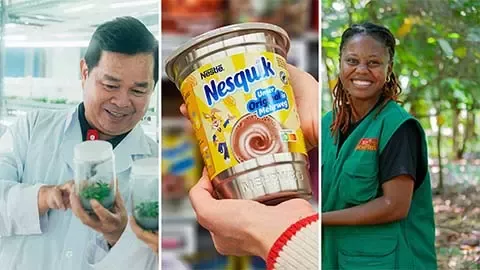
In previous years, we have had over 20 pilot consumer solutions in different Markets around the world. That includes a pilot that Nestlé France launched with Le Fourgon for KitKat and Nestlé Dessert products in reusable stainless-steel containers through a deposit-return system. In this pilot, consumers received products in reusable containers that were collected after use, washed and returned to circulation, demonstrating the application of reuse systems in everyday grocery categories.
More needs to be done to scale up reuse and we are collaboratively working with different coalitions, such as Consumer Goods Forum and the Ellen MacArthur Foundation along the value chain to enable conditions, including supporting legislation, packaging standards, transport and consumer incentives. We advocate for reuse and refill together with more than 300 organizations through the Business Coalition for a Global Plastics Treaty.
What have you put in place to explore bio-based and compostable packaging materials?
We established the Nestlé Institute of Packaging Sciences based in Lausanne, Switzerland, in 2019 to help deliver solutions related to our packaging sustainability strategy.
The institute conducts research to fundamentally rethink packaging materials and how we use them to deliver longer-term practical solutions. It works with our global R&D network, universities and innovation partners to do this.
As well as conventional types of materials, which are known to be recyclable, we are also exploring the potential of bio-based and biodegradable materials and systems to determine which role they can play in packaging food products safely and sustainability attributed.
One of the compostable packaging formats we sell today (in countries like the Netherlands) is the Nescafé Dolce Gusto NEO coffee pod.
How is Nestlé collaborating with industry peers and other parties to advance packaging sustainability?
Packaging circularity cannot be achieved by any single company acting alone. A package can be designed for recycling, but it will only be recycled in practice if collection, sorting and recycling systems are available and working at scale. This is why collaboration is central to our approach.
We work with a wide range of partners to help drive system-level change:
- Industry peers and coalitions. We advocate jointly for better recycling systems with more than 300 companies through the Business Coalition for a Global Plastics Treaty, which supports an ambitious, legally binding UN treaty addressing the full lifecycle of plastics.
- Standard-setting organizations. Our engagement with the Ellen MacArthur Foundation and its Global Commitment has provided common definitions and measurement principles for terms such as reusable and recyclable, helping us track and communicate progress on a comparable basis with other signatories. The collaboration reinforced that addressing packaging waste requires not only better packaging design, but also stronger collection, sorting and recycling systems, supportive policies, consumer participation and value chain partnerships.
- Governments and regulators. We support the development of well-designed, harmonized regulation, including effective Extended Producer Responsibility (EPR) schemes that can provide stronger systems and stable funding for collection and recycling, create a level playing field, and improve access to recycled materials.
- Suppliers, recyclers and local partners. Through our Packaging Recovery and Recycling Plan and other initiatives, we work with waste management companies, Producer Responsibility Organizations and local communities to strengthen collection, sorting and recycling infrastructure in more than 20 countries.
Through these partnerships, we aim to combine action within our own control, such as reducing unnecessary packaging and improving design, with the wider changes in infrastructure, regulation and consumer behavior that are needed to build a circular economy for packaging.
Compostable
A material is considered compostable (whether suitable for home or industrial composting) when, through microbial activity, its biodegradable components break down to form compost as well as naturally occurring gases and water under both aerobic and anaerobic conditions.
Recyclable
As defined in the Ellen McArthur Foundation reporting guideline definitions, a packaging or packaging component is recyclable if it is successfully post-consumer collected, sorted and recycled with a recycling rate of 30% in multiple regions, collectively representing more than 400 million inhabitants.
Reusable
Following ISO 18603, reusable is the characteristic of a product or packaging that has been conceived and designed to accomplish within its lifecycle an expected number of trips, rotations or uses for the same purpose for which it was conceived. The weight of reusable packaging is defined by the total weight of reusable packaging, divided by the number of expected rotations over the entire life of the package.
Virgin plastic
Plastic that has not been previously used or subjected to processing other than for its original production. It includes fossil and bio-based plastics.
Extended Producer Responsibility (EPR)
EPR is a policy approach that makes producers responsible for their products along the entire lifecycle, including at the post-consumer stage.