
Cocoa sourcing

Cocoa is a key ingredient in our confectionery and snacking products.
We are aiming to help cocoa-farming families and the environment they operate in overcome the challenges that cultivating cocoa can involve, such as, child labor risks, low incomes for cocoa-farming households and the associated risk of deforestation.
Our progress
96.2
%
178821
2075278
1 The percentage of cocoa sourced through the Nestlé Cocoa Plan includes volumes of Rainforest Alliance-certified mass balance cocoa. It also includes verified Nestlé Cocoa Plan volumes and farm data provided by suppliers.
Learn more in the Environmental Disclosures section of our 2025 Non-Financial Statement (pdf, 18Mb).
In 2009, we launched the Nestlé Cocoa Plan.
We launched the Nestlé income accelerator program in January 2022. This innovative family-centered approach is aiming to close the gap to a living income and reduce child labor risks.
Our approach to sourcing cocoa
Through the Nestlé Cocoa Plan we are working with farmers, communities and local and international organizations to develop and implement solutions to the challenges facing cocoa-farming communities.
In addition to our work with farming communities, our cocoa suppliers must comply with our Responsible Sourcing Core Requirements (pdf, 2Mb). Our performance of 96.2% by the end of 2025, reflects the steps we have taken to strengthen our processes. This has occurred alongside challenges in the global cocoa supply chain (caused by increased market volatility), supply shortages, and the need to secure a continuity of cocoa supply for our products. We are incorporating lessons learned from the challenges outlined above as we work on our plans for the coming years. Learn more in the Environmental Disclosures section of our 2025 Non-Financial Statement (pdf, 18Mb).
Key terms explained
Responsible sourcing
For Nestlé, responsible sourcing means improving the traceability of our ingredients and monitoring how they are produced. This involves applying our environmental and human rights requirements - detailed in our Responsible Sourcing Core Requirements (pdf, 2Mb) - at the different stages of our supply chain. Examples of these requirements include that land and resources of Indigenous peoples and local communities are respected and that no deforestation and no conversion of forests and other ecosystems occur in our supply chain. Read more about responsible sourcing.
Responsible sourcing
For Nestlé, responsible sourcing means improving the traceability of our ingredients and monitoring how they are produced. This involves applying our environmental and human rights requirements - detailed in our Responsible Sourcing Core Requirements (pdf, 2Mb) - at the different stages of our supply chain. Examples of these requirements include that land and resources of Indigenous peoples and local communities are respected and that no deforestation and no conversion of forests and other ecosystems occur in our supply chain. Read more about responsible sourcing.
Our income accelerator program
Launched in January 2022, the Nestlé income accelerator program was first introduced in Côte d'Ivoire and is now also being rolled out in Ghana.
This innovative family-centered approach is aiming to close the gap to a living income and reduce child labor risks. The program is built and designed to encourage changes in behavior and reward practices - both within the home and on the farm - focusing on four key areas: cocoa farm productivity, school enrolment, agroforestry, and additional incomes.
The program rewards cocoa farming families for practices that benefit the environment and local community. These rewards are delivered through incentives, reaching up to 500 EUR, directly into the hands of the two heads of the household via registered 'mobile money' accounts that ensure security and traceability. By prioritizing a family-centered approach, the program emphasizes the importance of women as catalysts for positive change.
Today, the Nestlé income accelerator program includes more than 30 000 cocoa-farming families in Cote d'Ivoire and Ghana with the ambition to reach, where relevant, an estimated 160 000 families.
According to a progress report published by KIT Institute in 2026, the program is making good progress with an encouraging +190% of cocoa net income (USD) vs. 2022 and +4% in cocoa production (kg/ha) vs. 2022.

Three pillars of the Nestlé Cocoa Plan
-
Better farming Aiming to improve livelihoods in communities.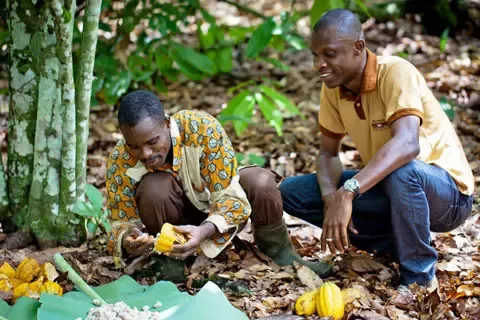
-
Better lives Aiming to improve social conditions for families.
-
Better cocoa Aiming to improve product sustainability.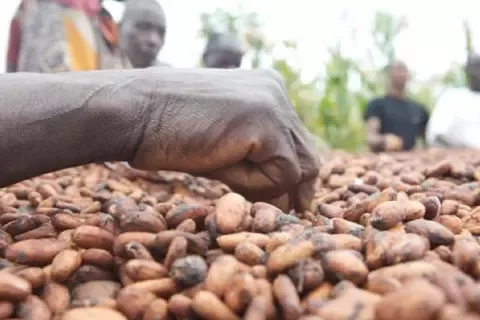
Better farming - aiming to improve livelihoods in communities
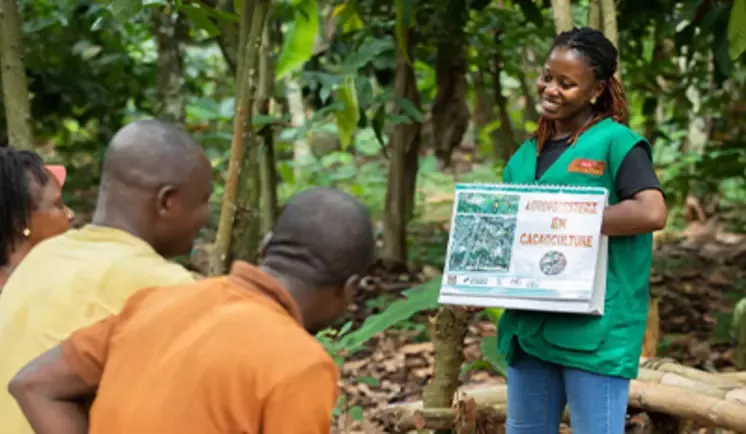
We are providing farmers with training in good agriculture practices (GAPs) to help improve their livelihoods including integrated pest and weed management, pruning, and planting shade trees to improve yields and increase resilience.
Farmers are trained in GAPs via field schools and through individual coaching, with adoption of GAPs incentivized in line with Nestlé's promotion of regenerative agriculture methods. The GAPs training is intended to help farmers reduce disease rates in crops, improve bean quality, rejuvenate plantations and manage land more sustainably.
In addition, to help diversify farmer incomes, we provide training and materials to grow or process crops like cassava, rear livestock such as chickens, and keep bees to produce honey.
The Nestlé team manages some aspects directly, including the supervision of shade tree nurseries, gender training for cooperatives and the development of video training. We subsidize pruning groups to improve productivity, and trial new ideas that our suppliers can take to scale. We aim to develop long-term relationships with cooperatives, and several have been working with us for over eight years.
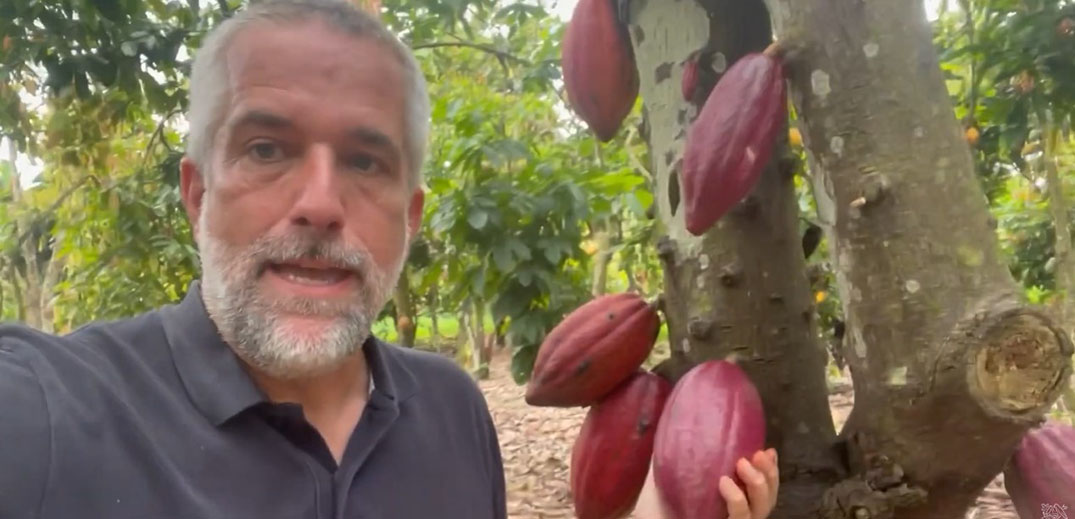
This footage was filmed on a mobile phone, which may affect the audio-visual quality.
Key terms explained
Regenerative agriculture
In line with the Sustainable Agriculture Initiative Platform, Nestlé defines regenerative agriculture as an approach to farming which aims to conserve and restore natural resources, primarily soil, as well as water and biodiversity, while capturing carbon in soils and plant biomass, and to support farmers’ livelihoods. Examples of regenerative agriculture practices include reduced tillage and agroforestry. More information is available in our Nestlé Agriculture Framework (pdf, 19Mb). Read more about regenerative agriculture.
Regenerative agriculture
In line with the Sustainable Agriculture Initiative Platform, Nestlé defines regenerative agriculture as an approach to farming which aims to conserve and restore natural resources, primarily soil, as well as water and biodiversity, while capturing carbon in soils and plant biomass, and to support farmers’ livelihoods. Examples of regenerative agriculture practices include reduced tillage and agroforestry. More information is available in our Nestlé Agriculture Framework (pdf, 19Mb). Read more about regenerative agriculture.
We are very pleased with progress, especially in starting to transform the way cocoa is farmed, with professional groups now pruning to a high standard. Gender empowerment is key to the program, and it’s great to learn about the impact of women’s decision-making in many households.

Better lives - aiming to improve social conditions for families
Together with our partners, we are supporting women in cocoa-growing communities through Village Savings and Loans Associations (VSLAs), empowering them and improving their access to finances. We are also tackling child labor risks through the Child Labor Monitoring Remediation System (CLMRS) that we created in 2012 in partnership with the International Cocoa Initiative (ICI) and is today an industry standard.
Better cocoa - aiming to improve product sustainability
We are moving towards a more transparent and traceable supply chain, continuing to develop certification and verification. At Nestlé, we are using various traceability schemes, including mass balance, segregated, and mix identity preserved. Read more about the different levels of traceability.
Increasing traceability in a complex cocoa supply chain
For specific cocoa origins, such as Brazil, Ecuador or Venezuela, and for local usage, we follow a Nestlé Cocoa Plan verified approach (verified by independent third parties).
We are continuing to enhance our traceability systems. This will allow us to increase our understanding of risks in cocoa production, such as the risks of child labor or deforestation, and continuously work on addressing those risks in an effective manner.
Our cocoa suppliers (pdf, 200Kb) manage the commercial relationship with cooperatives and most of their sustainability activities, including Rainforest Alliance certification where relevant.
Discover more about Rainforest Alliance cocoa certification and on the different traceability levels.

Growing cocoa in a forest environment
Cocoa plants grow better and produce healthier crops when grown beneath the canopies of larger trees, which cast shade on the cocoa.
As part of our Net Zero Roadmap and income accelerator program, we are supporting the planting of native forest and fruit trees for Cote d'Ivoire (like fraké, irvingia, akpi, framiré, bété and pepper) to protect their crops from heat stress and excessive rainfall. These trees also help to improve water management, local biodiversity, soil organic matter and carbon sequestration. They also have the potential to provide additional income sources for farmers.
Through the Nestlé Cocoa Plan, we have distributed 2.07 million forest and fruit trees globally. Learn more in the Environmental Disclosures section of our 2025 Non-Financial Statement (pdf, 18Mb).
Key terms explained
Net zero
Nestlé has committed to reaching net zero greenhouse gas (GHG) emissions by 2050 at the latest. In 2020, we published our timebound plan, the Nestlé Net Zero Roadmap (pdf, 16Mb), which underpins our Group’s climate strategy and acts as our transition plan aligned with a 1.5°C pathway as validated by the Science-Based Targets initiative (SBTi). We will balance any remaining emissions through high-quality natural climate solutions. Read more about net zero.
Net zero
Nestlé has committed to reaching net zero greenhouse gas (GHG) emissions by 2050 at the latest. In 2020, we published our timebound plan, the Nestlé Net Zero Roadmap (pdf, 16Mb), which underpins our Group’s climate strategy and acts as our transition plan aligned with a 1.5°C pathway as validated by the Science-Based Targets initiative (SBTi). We will balance any remaining emissions through high-quality natural climate solutions. Read more about net zero.
Reporting transparently on deforestation
Since 2020, we have reported annually on how we are tackling deforestation and promoting regenerative agriculture practices among cocoa farmers in Côte d'Ivoire and Ghana.
Our CFI progress report shows our commitment to the Cocoa & Forests Initiative (CFI). The CFI is a consortium of 35 leading cocoa and chocolate companies representing 85% of global cocoa usage and led by the governments of Côte d'Ivoire and Ghana, which aims to end deforestation and restore forest areas.
We recognize the need to accelerate and scale via collective action and co-investment in priority landscapes, in addition to supply-chain investments.
Thriving forests and committed communities
The Cavally Forest Reserve is one of Côte d'Ivoire's major preserved ecosystems, home to elephants and rich biodiversity, yet it faces degradation from illegal mining, logging, and cocoa farming. Today, with government-led patrols, community partnerships, and satellite monitoring, the forest is steadily recovering - both naturally and actively.
We saw the forest cover within the Cavally forest increase by 10% since 2018, with over 7 000 hectares regenerating naturally by 2024. This enhanced connectivity supports wildlife habitats, notably benefiting the approximately 250 forest elephants. We also established 972 hectares of forest, with 26 092 native trees planted in the Cavally Forest Reserve.
With governance now in place, some of the most dynamic progress is emerging from local communities. In 2024, over 2 300 farmers participated in good agricultural practices training, often hosted by cooperatives in small-group sessions that foster knowledge exchange and local resilience.
It motivates me to see farmers convinced of the benefits: over 90% want to continue pruning and some already pruned the remainder of their plot.