Facts and figures

Explore the key facts and figures that reflect our performance and global reach.
Our business
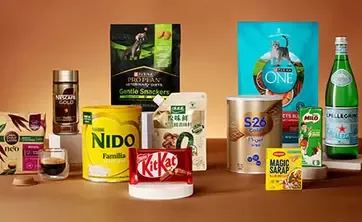
We apply our expertise to help people and pets live happier, healthier lives. The categories reported reflect our 2025 Annual Report. In 2026, we announced an update to our operating segments.
What we sell
Powdered and
Liquid Beverages
28.1%
PetCare
20.6%
Nutrition and
Health Science
16.0%
Prepared dishes
and cooking aids
11.3%
Milk products
and Ice cream
10.8%
Confectionery
9.7%
Water
3.5%
Where we sell
Zone Americas
48.0%
Zone Europe
25.2%
Zone Asia, Oceania and Africa
26.8%
Number of countries we sell in
185
Our financial performance
A summary of the 2025 full-year results is shown here. For full results, please consult the Financial review section.
Group sales (in CHF)
89.5
billion
Organic growth *
+
3.5
%
Real internal growth *
+
0.8
%
Underlying trading operating profit * (in CHF)
14.4
billion
Underlying trading operating profit margin *
16.1
%
Underlying trading operating profit margin *
-
100
basis point
Trading operating profit* (in CHF)
12.7
billion
Trading operating profit margin*
14.2
%
Trading operating profit margin *
-
170
basis point
Earnings per share (in CHF)
3.51
Earnings per share (in CHF)
-
16.3
%
Underlying earnings per share *
-
1.8
%
Operating cash flow (in CHF)
15.9
billion
Free cash flow * (in CHF)
9.2
billion
Proposed dividend (in CHF)
3.10
Proposed dividend increase
+
1.6
%
* Financial performance measures not defined by IFRS.
Our key non-financial performance
To measure our progress, we use a comprehensive set of indicators that support our business performance and generate value for our shareholders and other stakeholders. Some key performance indicators are included here – the full set is in our Non-Financial Statement (pdf, 16Mb).
Climate
We aimed to reduce our greenhouse gas (GHG) emissions by 20% by 2025, which we achieved. We aim to further reduce such emissions by 50% by 2030, on the road to net zero by 2050 at the latest.
*Covers emissions related to our net zero targets. Net reductions (%) include removals from inside Nestlé’s value chains and sourcing landscapes.
Our KPI
24.5
%
Nature
By 2025, we aimed to achieve and maintain 100% assessed deforestation-free primary supply chains (for meat, palm oil, pulp and paper, soy, sugar, cocoa and coffee). Our performance by the end of 2025, at 96.9%, reflects over a decade of investment in traceability, supplier engagement and landscape-level interventions, while being challenged by operational complexities, particularly in extended supply chains and geographies with limited verification infrastructure. In cocoa, based on the learnings of previous years, we have focused our deforestation-free efforts on 'first-mile traceability' (i.e. tracking beans from their origin to the supplier's first point of aggregation). This approach aligns our assessment with emerging industry practices and reinforces the integrity of our traceability systems at the start of the supply chain.
The gap between our performance and meeting our commitment in full is due to traceability and infrastructure challenges in global commodity supply chains. Our commitment stands but reflects this complexity. That is why, from 2026 onwards, we aim to maintain 95%-100% assessed deforestation-free primary supply chains for meat, palm oil, pulp and paper, soy, sugar, cocoa and coffee.
Our KPI
96.9
%
Regenerative Agriculture
By 2025, we aimed for 20% of volumes of key ingredients to be sourced from farmers adopting regenerative agriculture practices, which we achieved. We now aim to achieve 50% key ingredient volumes sourced from farmers adopting regenerative agriculture practices by 20302.
Our KPI
27.6
%
Packaging
By 2025, we aimed to reduce virgin plastics by one third versus our 2018 baseline. We continue to work on reducing unnecessary packaging and increasing the use of alternative materials and recycled content, while ensuring that packaging continues to protect food safety, quality and prevent food loss and waste. We have set a new target to reduce our use of virgin plastics by 12-17% by 2030, against a 2018 baseline.
Our KPI
28.0
%
Diversity, equity and inclusion
Our KPI
48.2
%
Health and nutrition
Our KPI
135.4
billion
To measure our progress, we use a comprehensive set of indicators that support our business performance and generate value for our shareholders and other stakeholders.
Non-financial performance metrics are defined in the 2025 Reporting Scope and Methodology for ESG Key Performance Indicators (KPIs) - Appendix 1 in the Non-Financial Statement (pdf, 16Mb).
EY has performed limited assurance on the six key performance indicators on this page. The assurance statement with EY ’s independent conclusion can be found in the Non-Financial Statement (pdf, 16Mb).
1 This performance number differs from the one available in our Non-Financial Statement 2025 due to a change in the methodology during the first half of 2026. Now we consider ingredients volumes converted back to their original fresh state, instead of their processed form.
2 There has been a change in the key ingredients scope from 2026 onwards. The new scope is: cereals and grains; cocoa; coconut; dairy (derivatives and fresh milk); green coffee; hazelnuts; meat, poultry and eggs; soy; spices; sugar; vegetables; and vegetable fat oils (including palm oil).
Key terms explained
Regenerative agriculture
In line with the Sustainable Agriculture Initiative Platform, Nestlé defines regenerative agriculture as an approach to farming, which aims to conserve and restore natural resources, primarily soil, as well as water and biodiversity, while capturing carbon in soils and plant biomass and to support farmers' livelihoods. Examples of regenerative agriculture practices include reduced tillage and agroforestry. More information is available in our Nestlé Agriculture Framework (pdf, 19Mb). Read more about regenerative agriculture.
Virgin plastic
Plastic that has not been previously used or subjected to processing other than for its original production. It includes fossil and bio-based plastics.
Net zero
In 2019, we announced our ambition to reach net zero GHG emissions by 2050 at the latest. In 2026, we updated our timebound plan, the Nestlé Roots of Net Zero (pdf, 14Mb), which underpins our Group's climate and nature strategy and acts as our transition plan aligned with a 1.5°C pathway as validated by the Science Based Targets initiative (SBTi). We will balance any remaining emissions through high-quality nature-based solutions, such as agroforestry, silvopasture and the restoration of forests and peatland. Read more about net zero.
Deforestation-free
Deforestation-free means that commodities in scope were assessed as produced on land that has not been subject to deforestation or conversion after a specific cut-off date that varies by commodity, but no later than December 31, 2020. Commodities accounted as deforestation-free include in part commodities subject to the requirements of the EU Deforestation Regulation. However, the scope of the disclosed metric goes beyond these jurisdiction-specific mandatory requirements as part of Nestlé's global approach on deforestation. Read more about deforestation.
Regenerative agriculture
In line with the Sustainable Agriculture Initiative Platform, Nestlé defines regenerative agriculture as an approach to farming, which aims to conserve and restore natural resources, primarily soil, as well as water and biodiversity, while capturing carbon in soils and plant biomass and to support farmers' livelihoods. Examples of regenerative agriculture practices include reduced tillage and agroforestry. More information is available in our Nestlé Agriculture Framework (pdf, 19Mb). Read more about regenerative agriculture.
Virgin plastic
Plastic that has not been previously used or subjected to processing other than for its original production. It includes fossil and bio-based plastics.
Net zero
In 2019, we announced our ambition to reach net zero GHG emissions by 2050 at the latest. In 2026, we updated our timebound plan, the Nestlé Roots of Net Zero (pdf, 14Mb), which underpins our Group's climate and nature strategy and acts as our transition plan aligned with a 1.5°C pathway as validated by the Science Based Targets initiative (SBTi). We will balance any remaining emissions through high-quality nature-based solutions, such as agroforestry, silvopasture and the restoration of forests and peatland. Read more about net zero.
Deforestation-free
Deforestation-free means that commodities in scope were assessed as produced on land that has not been subject to deforestation or conversion after a specific cut-off date that varies by commodity, but no later than December 31, 2020. Commodities accounted as deforestation-free include in part commodities subject to the requirements of the EU Deforestation Regulation. However, the scope of the disclosed metric goes beyond these jurisdiction-specific mandatory requirements as part of Nestlé's global approach on deforestation. Read more about deforestation.
Explore more of our Annual Report


Downloads
Nestlé's Annual Report includes our Annual Review, Corporate Governance Report, Compensation Report, Financial Statements and Non-Financial Statement.