
Field Good podcast

Dive into the world of regenerative agriculture. In each episode, a farmer and an expert share their stories and experiences. A change is happening, let’s talk about it!
Featured episode
How regenerative agriculture can help address supply chain challenges?
Farmer Victor Parmentier joins Bastien Sachet, CEO of the nonprofit Earthworm, to explore how healthier soils can help address supply chain challenges.
Victor grows onions for Maggi and works on Nestlé’s sustainable agriculture team, helping other farmers put regenerative agriculture into practice. Drawing on his experience, this episode explores:
- How cover crops and reduced tillage can help protect soil, retain water and support biodiversity
- Why the transition takes time, investment and a willingness to learn what works on each farm
- How sharing knowledge and equipment can help farmers manage costs and adopt new practices
- Why collaboration across the food supply chain matters for lasting change
For Victor, progress is visible: cover crops have helped reduce rainwater runoff, while reduced tillage has lowered fuel costs. His story brings the opportunities and challenges of regenerative agriculture down to earth.
Listen on: Apple Podcasts Spotify YouTube More
This transcript may have been edited for clarity
Host: You’re listening to Field Good, a podcast by Nestlé. In each episode, we dive into the world of regenerative agriculture. Farmers and experts share their stories and experiences. A change is happening, let’s talk about it.
Welcome to Field Good. In this very first episode, we start at the beginning by laying the groundwork for thinking around regenerative agriculture. How can we, as a collective, address supply chain challenges? We decided to bring together Victor Parmentier, a French farmer, and Bastien Sachet, CEO of Earthworm, an international non-profit organization that works with companies in their supply chains to regenerate soils and forests.
But before diving into the heart of the matter, follow me through the story of Victor, an ambitious farmer always on the lookout for something new.
It's winter 2023 in Vic, a commune of about 300 people in the north of France. Victor Parmentier has just returned to the family farm where he grew up to work alongside his father. He watches the rain come down on the fields they’ve recently tilled in preparation for planting sugar beets. Ideally, that rain should penetrate deep into the soil to retain moisture for the seeds that will soon be deposited.
A quick glance over to the bordering road reveals this isn't exactly the case. Part of the water has run off the surface, flowing down the concrete and carrying soil with it in the process. Victor is far from alone when it comes to facing daily challenges like this, that can be problematic both in terms of cost and environmental impact.
Victor wears two hats. He's an individual farmer whose onions are used in Nestlé's Maggi products and is part of the sustainable agriculture team at Nestlé, where he works with hundreds of farmers in the company's supply chain to deploy regenerative practices. Whether it means reducing tillage or implementing cover crops, these techniques are helping farmers today make long-term investments in the health of their soil, while also managing costs in an increasingly competitive economic environment.
Victor is making this transition alongside the farmers his work supports. Shortly after returning to the 400-hectare farm to work alongside his dad, he took over and began a transition to regenerative agriculture practices.
Thanks to his role at Nestlé, Victor was able to dive deep into regenerative agriculture by training in some new techniques, visiting different farms to see what was working or not working, and talking to neighbouring farmers who had already started transitioning to some of these practices.
Every farm is different, which almost always means some trial and error is necessary. It can take a few years before farmers see a return on their investment, but Victor's patience has slowly started to pay off. For example, a reduction in tilling has meant lower fuel costs. Keeping the fields covered by crops year-round has reduced the prevalence of weeds and improved biodiversity. Plus, the increased soil health means less of a need for synthetic fertilizers. Today, Victor says he's able to generate the same yields and margins as his neighbours using conventional methods.
Victor is using his own experience working with other farmers to exchange knowledge, turning regenerative agriculture from broad concepts into real, on-the-ground practices with genuine economic value.
Regenerative agriculture isn't just a set of practices. It's a journey. Victor has had to balance environmental ambitions with the realities of running a profitable business. But questions remain:
How can regenerative agriculture be scaled across entire supply chains? What support do farmers need to make the transition? And how can companies help create the conditions for lasting change?
To explore these questions, Victor is joined by Bastien Sachet, CEO of Earthworm Foundation. Let's join their conversation.
Bastien Sachet, СEO of the nonprofit Earthworm: Hi Victor, how are you?
Victor Parmentier, Farmer: Hi Bastien. Very well, and you?
Bastien: Yes, not too bad. Where are you at the moment?
Victor: At the Nestlé headquarters in France, next to Paris. So I just came from the farm this morning. And you?
Bastien: Okay, I'm in Switzerland where the head office of Earthworm is, in Nyon. It's raining, finally, here after months of drought.
Victor: Yeah, we had a bit of rain yesterday also.
Bastien: Okay. And you have a farm, maybe you can share a little bit about it, and where it is, and a bit the history of the farm, because I think your father was a farmer as well, right?
Victor: Yeah, I took over the farm after my father. We worked two years together as I was already at Nestlé, and so we drove this change from 100% Nestlé to now 20 or 30% Nestlé. Now I'm running the farm, we are kind of trying to change some practices. You've seen this year was really hard, we had no rain for a few months. Now we are a bit afraid of when it will start to rain, it won't stop, it's what we heard in a discussion between farmers. So we need to find ways of being ready and drive the crops the best as we can.
Bastien: I know, because I've seen some of your LinkedIn posts and knowing a bit what you do, that you've switched toward a more regenerative practice or conservation agriculture practice. Can you share a little bit about why you moved and how you moved into that? Was it a decision you made or your father made, how did that happen?
Victor: My father started with me, but at least he was open to it. So it's first thing great to support me in this journey. A few things, I think first, I've seen yields are capping or more and more unstable, so some years we had big yields, sometimes we have very poor. So we need to find a way to make this more stable. And also, in the other hand, we've seen the costs raising constantly. So the margins are very unstable and sometimes they are negative, so it's not the good way to work.
In another hand also, we understand that we have an impact on the biodiversity. We've seen the soil, or we understand more and more the soil to be a worker that we need to have on our side, and we need to work beside the soil. So I'm trying to put all these things in the same way of cropping, and so I started to work a bit on the regenerative agriculture practices. Also because I think I have a few different crops, but also industrial crops, vegetables, sugar beets, and I think we have a higher impact on the soil, so I really want to make the soil healthier and have less negative impact. So yeah, we started to work a bit on this.
Bastien: So, double motivation, huh? You're talking about reducing costs, managing costs, but also taking care of the soil and preserving the capital of the farm. So you are encouraged to continue by what you're seeing, by the results: on one side some less costs, and on the other side some interesting visual things that you can see on the soil, on the erosion, as you said, right?
Victor: Yes, and I think you also have some experiences on this, you've seen other farms or maybe companies also pushing on this way.
Bastien: Yeah, it's true. A lot of the work that we do is about supporting companies and then supporting farmers, you know, realize that transition towards regenerative agriculture, because our mission is to support the regeneration of soils and forests with and for people. And so, we're a bit like the earthworm in the soil, huh? The earthworm in the soil navigates between the surface and the depth, and we do that within the supply chain, between large companies like Nestlé and farmers like you, where we try to bring the support that is needed to succeed.
On our side, we've identified three types of support:
- One is the measurement: how do we measure, how do we characterize, you know, this regenerative agriculture? When do we say a soil is healthy?
- Two, how do we support technically?
- And three, how do we support economically, de-risk the transition, because as you said, you've had some failures and this probably led to costs.
And so the program we have tried to develop is to help farmers all along the way by getting corporates, brands like Nestlé, you know, to support and work together around the crop rotation of the farmer and to incentivize with funding but also supporting the technical support of farmers. So this gives them an environment that allows them to try and to transition.
Victor: So with your point of view, Bastien, what are the pros and the cons of transitioning into regenerative agriculture? And maybe you have seen things working and things that have failed also?
Bastien: From my point of view, a lot of the regenerative agriculture transition movement over these last years has been very much driven by a carbon imperative, a need to reduce emissions. And since companies always need to tie their financial incentives to carbon incentives, many programs have been done in the field asking farmers to reduce emissions.
But regenerative agriculture is much more about having a healthy soil than reducing emissions. Some things that I've seen failing, not in the program that we run, but some programs that I've watched, where there is a hyper focus on carbon, the money is not used to de-risk the farmer; it's used to pay for the farmer to buy fertilizer that are more expensive because they are low carbon emissions or they've been manufactured with a green energy, and therefore they are more expensive. That creates a long-term dependency, and it doesn't solve really the resilience issue of the soil. So for me, this is kind of a failure.
What I see happening very well is when there is a real dialogue between the companies, the cooperatives, and the farmers around how do we crack that together. Which means that the challenges are shared in an open way, be they financial, even in, you know, deciding where the premium should be and what is enough money to de-risk the transition, when long-term contracts are being made, and then when the farmers are really supported and active.
Victor: So thanks to your experience, you may have some cases to share with us to illustrate the urgency of the situation?
Bastien: So, I think the urgency of the situation is linked to two parameters:
One is the climate urgency, and we had very severe drought this summer, and we can see the crops that were sown in the spring have given very low yield, for example, the sunflower, sometimes -30%, -50% of yield. Even large crops, you know, like barley, spring barley or spring wheat have suffered. On the dairy side, we also have seen the effects of climate change, and the cows that were really, you know, trying to find shade and freshness, and the yield of the cows have gone down, especially when there were no trees where they could take a little bit of shade. They would go back inside and in a very overheated barn, and they would suffer a lot and the milk production collapsed.
And then the second urgency that I see is a geopolitical urgency with the Ormuz Strait being blocked, the Ukraine-Russia situation, which have contributed to make the cost of nitrogen fertilizer, who are very much used by farmers in arable crops, explode. And I have this example of farmers in the south of France that have not even put corn into the ground because the cost of fertilizer was too high and they decided that it didn't make any business sense to do that.
So the urgency to get the soil to be a sponge and resist drought and too much water, resist and adapt to climate change, the need to close the fertility loops and have more nitrogen produced on the farm so that you depend less on the one that comes from the Middle East or from Russia is key. And that is exactly what regenerative agriculture proposes.
So somehow the urgency of the situation is just, you know, accelerating the transition, or forcing to accelerate. And that's where we all are grappling with how we do this where the amounts of money to support farmers are not available in large quantities, so we have to figure out the solutions.
But I'm quite optimistic because we have some examples of farmers that are successful, that have, for example, reduced completely their insecticides, that are using less nitrogen. We have these big projects we are working on together with Nestlé, with a coop in the north of France where we've seen increasing of soil cover, like plus 20 days. We have more nitrogen autonomy, like plus 10-12% that we've seen in some cooperative that we have been working a long time with, I'm thinking about Noriap, and in the north of France, you know them well, Victor. And so this is all just very nice stories. Maybe, Victor, you know about others because you also have...
Victor: I think one thing I can share is also on the urgency of the situation is for when I see on my farm. So on my farm, for example, you spoke about the nitrogen cost, the fuel cost. For the past years, at this time where we speak in October, I'm used to be 100% covered in nitrogen for the next harvest, so for 2027, and for now I think I'm not at half of my cover. So we know that we will have to buy, but we are in a very dangerous phase of the alimentation production.
And for the fuel costs, yeah, for this year for the wheat, for example, I already sown 1/3 of my wheat without tilling the soil, so direct seeding. So it's the first time for me, but I think it was the best year to do it because I decreased the fuel consumption, I think about 50 or 70% for the seeding operation.
Bastien: So what's interesting with you, Victor, is you're also an agronomist. Where did you learn the most about these practices and how did you get to familiarize yourself? Because it's often a multifaceted journey, what was your journey to get familiar with regen ag?
Victor: I studied in Angers agronomy; I graduated in 2020. I think I went out with a lot of agronomic aspects in the head, a lot of consideration for the soil. I had already this project to work with companies to find a way of giving more value to farmers working into regenerative practices. So I think I arrived at the good step of the Nestlé thinking. When I arrived, they were starting to think the link between climate, the crop production, their own also production. So I arrived at this stage. During my internship, I learned a lot of what was the impact of the farming practices on the climate, but also what the climate has impact on the farms.
So I think both, I learned a lot of practices at school, then impacts at Nestlé, and then I had the opportunity to work with a lot of different farms and also advisors, so I learned a lot in field on the practices and how to drive change at farm level.
Bastien: All clear. It's interesting because the school can put a seed, but the seed grows in the field really, with practitioners. I feel regenerative agriculture is a lot about practitioners and experiencing things, rather than having big concepts that are being taught in the academia. Although I'm encouraged to see the schools and the academia learning from the experience and then distributing, diffusing, and amplifying everything that is being learned. But it's, I always say it's a bit the beginning of a very interesting agroecological journey that the whole humanity is relearning again or learning again, which is fascinating.
One thing that I find interesting is all the innovation that is linked to the technical innovation around the farm. So you mentioned less tillage, the cover cropping, the species you put, etc., so there's this whole technical innovation part. But there is also a way of working. Innovation is very much around the collaboration and how actors work differently together. And I remember that in many supply chains it's very transactional: you produce a crop, you sell it to a coop, and then it disappears. And then suddenly with this kind of projects which is vertical and horizontal as well between players has been quite interesting.
I wonder whether you could share a little bit about how you've done that both at Nestlé and as a farmer, because you've been involved and we've been involved together in some of those projects.
Victor: Yeah, you're right. You see, first thing, for example, when I graduated, I never thought I would work for Nestlé. As a farmer, I never imagined that they would be interested into farming practices. So first thing, and now things change and these companies are learning, relearning to work with farmers and with yearly harvest condition, yearly harvest quality, etc. So this is very important, and I think it will go until the consumer at the end.
And thanks to this collaboration, as you said, we've seen farmers saying: "Ah, okay, I am producing wheat for Friskies, for Purina." So they went to visit the factory, and they understand why we were asking for certain quality, and at the factory they understood why we had some troubles at field to get this quality. So we create exchanges and we create arrangements between jobs, and this is very rich.
And then in the supply chain, we need also to collaborate with the other companies that are buying, as you said, other crops at farm level to see the farmer interested. When you see all your clients asking for something different or supporting you for new practices, you understand that you have to go there and you are covered by your clients, and this is very powerful to drive the changes.
Bastien: This vertical collaboration is fantastic, and I've seen also something really interesting is to start from the farm again. I remember a time 10 years ago where every company was coming with their own set of criteria: the Nestlé criteria, the Danone criteria, this certification or this label, the CRC, the Label Rouge, etc. So there was a flurry of criteria, and for the farmer is like: "Ah, come on, I've got one farm, but I need to fit for this crop this request, for this for that."
And what I found really interesting is that by looking around one set of indicators, which is some of the work we've initiated together with you at Nestlé, is to say: "Okay, let's look at the whole farm with one set of indicators, and then let's make sure that everyone aligns to these indicators." And I think these projects that are now aligned in this way, it's much easier because everyone looks at the same way of measuring carbon, of measuring cover crops, etc. And so it starts from the farm and it goes into every supply chain. And that allows, having this standard allows all the companies to collaborate together and to say: "Okay, I'm going to support a bit", and everyone supports a bit the transition, and at the end it becomes significant for the farmer.
Victor: And aid farmer to go deeply into one direction, not on different ones, so I think we will drive more impactful changes by this way.
Bastien: Yeah, less bureaucracy, more impact, and more focus on what matters. Everyone says: "Oh yeah, but you know, environmental practices, regenerative agriculture, it's all nice, but we've got people to feed, right? We've got people to feed and we need to keep the production up, etc." I'm personally convinced that regenerative agriculture is key to feed 8 billion people. On your side, do you have a doubt, and what do you think about those who say that?
Victor: I think your point of view will have good value because also you have experiences all over the world, at least in France, as I know. I'll say yes, because I've seen farmers, I've seen trials, I've seen real fields having the same yields, sometimes better yields thanks to these practices. So I think, yes, we are able to feed the world population thanks to these practices. As I said, you will have more stable yields, so it's maybe better also for the people to have always the same amount of food and not having, okay, so this year we will have less potatoes, so it will be a bit more expensive on the market.
So for sure, I think we can do it, but if we go all together, supporting, thinking how to drive the change, and not asking the farmer to change from one year to the next one without support. I don't know what you've seen also on other maybe crops or countries?
Bastien: To me, opposing regenerative agriculture, which is seen as an environmental thing, to feeding people is completely wrong. Actually, regenerative agriculture is the way to continue to produce in a difficult climate. The current system is very fragile, and we see it with droughts, with pests. I have this example on cocoa in Ivory Coast, where half of the trees are sick, the farmers don't make money, it's a very fragile production in a way which is run in a conventional fashion, not with the principles of regenerative agriculture, and therefore there is not enough. And the price has rocketed up, it's very expensive now to buy chocolate, and because of that, everyone is worried about where the cocoa is going to come from since the consumption over the world keeps growing.
This is just an example, but it will happen to the other crops. Today, the price of palm has doubled because there is drought and the trees are producing less. Meanwhile, we see the farmers that are practicing regenerative agriculture managing to maintain the yield and not to go in those kinds of drops, because their soil are more like a sponge. So I really think that actually regenerative agriculture and feeding people goes hand in hand, because it's not an obstacle to production, it's an enabler of production.
Victor: So for you, it's more a way of feeding than a risk of not feeding the population?
Bastien: Yes, absolutely, because no one is coming to the farmer saying: "You can't do this, you can't do that, you should not use pesticides, you should not use fertilizer." We're more like: "How do we make the soil work better so that we face every type of geopolitical or climate change and we keep producing?" So it's really a tool for production, not a tool against production.
Victor: Agree, on the farm.
Bastien: Thanks Victor, it was great to speak with you again and I look forward to seeing you soon on the farm or in a meeting room.
Victor: Yes, thank you Bastien, my pleasure too. Please come on the farm, otherwise we'll see in a meeting room, as you said.
Bastien: Absolutely. Thank you.
Host: Thanks Victor Parmentier and Bastien Sachet for this first episode, and thanks for listening. We look forward to welcoming you back for the next Field Good conversation. To learn more about Nestlé's commitment to scale regenerative agriculture and what this means for their brands, visit nestle.com. See you soon.
END OF TRANSCRIPT
Explore more episodes from the series
How to make the transition profitable?
Farmer Joe Stanley and OP2B Director Stefania Avanzini explore financing regenerative agriculture and sharing the costs of the transition.
Joe is Head of Sustainable Farming at the Allerton Project, a research farm in Leicestershire, England. Once cautious of regenerative agriculture, he now supports others in making the transition. Drawing on his experience, this episode explores:
- What the transition can cost and how farmers can access financing
- How food companies, financial institutions and governments can help share costs and reduce risk
- Why training and farmer-to-farmer learning are essential investments
- What it will take for regenerative agriculture to be more widely adopted
Working with Nestlé, Joe researches where sustainable farming can be profitable and where wider support is needed. His experience highlights why farmers cannot be expected to fund the transition alone.
Listen on: Apple Podcasts Spotify YouTube More
This transcript may have been edited for clarity
Host: You’re listening to Field Good, a podcast by Nestlé. In each episode, we dive into the world of regenerative agriculture. Farmers and experts share their stories and experiences. A change is happening, let’s talk about it.
Welcome to Field Good. In this new episode, we ask an essential question: How can we make the transition to regenerative agriculture profitable?
To discuss this topic, we welcome Stefania Avanzini, director at OP2B, an international business coalition on biodiversity with a specific focus on agriculture, and Joe Stanley, farmer and head of sustainable farming of the Allerton Project, a regenerative agriculture research farm.
Before listening to their conversation, let me share the story of Joe, a determined farmer with great instincts.
It's dawn at the Allerton Project. At this farm, spread across 320 hectares in the rolling hills of Leicestershire, England, the morning soundtrack is provided by the usual suspects: yellowhammers and whitethroats. Thanks to 35 years of careful habitat management, feeding efforts, and predator control, the team has been able to increase the estate's songbird population by 150%. And this is just one of many examples of how biodiversity has flourished here thanks to their conservation efforts.
The Allerton Project isn't just a working farm, it's also a research hub for regenerative agriculture, where scientists and farmers work together to marry productive farming with cutting-edge regenerative practices and landscape management.
Here, Joe Stanley, head of sustainable farming, draws on the facility's wealth of research to confront a two-sided climate crisis: how to adapt farming practices to mitigate climate change when the effects of climate change have already made farming harder than ever. As England faces a string of its worst harvests on record, it's clear that business as usual is simply no longer an option.
Joe grew up not far from here on a traditional beef and arable farm, where his family has utilized conventional farming practices for three generations. As a kid, he was a regular fixture on the farm, but in his teenage years, he decided to forge his own path.
After studying history at university and undertaking a range of roles outside the farming industry, Joe ended up producing business conferences in London. But when his help was eventually needed back home, Joe dutifully returned to Leicestershire to run the family farm.
No one who has spent years honing their craft likes to be told by outsiders that there's a better way of doing things, especially not farmers. When it came to suggestions of adopting regenerative practices, Joe was at best sceptical, and at worst outright hostile. But after seven or eight years of sticking to the family playbook, he began to wonder: was there a better way to do things?
Eventually, Joe began engaging more broadly with the farming community, working with policy and farmer representation organizations like the National Farmers' Union. He began thinking more deeply about the sustainability of the farm system and regenerative issues. Within a couple of years, he had begun implementing more sustainable practices on his own farm.
It was becoming obvious to Joe that the benefits of regenerative practices were not only in terms of making his own farm more resilient, but to society at large: a cleaner water supply, better sequestration of greenhouse gases, and more biodiversity, just to name a few.
Since joining the Allerton Project, Joe has worked with Nestlé to research where sustainable farming can be profitable, and where other stakeholders like food manufacturers, retailers, government, and consumers need to step up to share the costs.
Joe's story highlights a reality many farmers face: while the benefits can be clear, the journey often comes with new costs and risks. Farmers around the world are asking how regenerative agriculture can become both environmentally and economically sustainable.
To explore those questions, Joe sits down with Stefania Avanzini, director at OP2B. Let's listen to their discussion about what it takes to support farmers through the transition, and how the wider food system can help make regenerative agriculture a practical and profitable choice.
Joe Stanley, Farmer and Head of Sustainable Farming at the Allerton Project : Good morning Stefania, how are you doing?
Stefania Avanzini , Director One Planet Business for Biodiversity, OP2B: Good, how about you, Joe?
Joe: I am good. We've had a reasonable amount of rain here in the UK, and I imagine, as with much of Europe, it was desperately needed. So quite happy with that from a farming point of view.
Stefania: I would love to know if from your research farm you have seen some evidence on how you overcome some of these economic challenges too, and how do you overcome the transition from an economic point of view?
Joe: There are some real benefits that we've seen at the Allerton Project and farmers in many places are seeing with regenerative agriculture, things such as a reduction in the use of synthetic fertilizers and of, you know, diesel fuel. And of course, that's important when, look, back in
2022 here in the UK, the price of nitrogen fertilizer quadrupled as a result of Russia's invasion of Ukraine. Those are the sorts of market volatilities we really want to be trying to move away from.
But also, you know, things like building resilience into your farm business through using things like deeper-rooting herbal leys, you know, grasses and herbs and legumes, which are more climate-resilient versus your sort of annual cropping. Yeah, there are ways we can make our farm businesses hopefully reduce both the costs, but also build resilience, soil health, of course, being the big one of those for the long term.
Now, of course, that's not a silver bullet, however. We must recognize that huge challenges remain in that transition, not least the upfront costs of paying for many of these measures, and the long term that it takes for many of those measures to start to benefit the farm, things such as improving soil health. Now, again, when farmers are struggling to make a profit, it can be a real challenge to encourage them to make that long-term investment, which in the short term might even make their businesses less profitable. It's very hard to think of five years down the line when you're struggling to put food on the table today.
So those are the big challenges. So there's some great cost savings that we can make in a regenerative system, but we also do have to appreciate there are costs of that transition as well.
Stefania: So Joe, what financial levers have enabled you to move towards more regenerative agricultural practices?
Joe: So here in the UK, obviously we left the European Union back in 2020/2021, and since then the Common Agricultural Policy mechanism has been replaced in England primarily by something called the Sustainable Farming Incentive. And ultimately that was the English approach to trying to encourage farmers to move down the regenerative route in terms of land management. And so there are payments available there for things such as growing cover crops, for things such as planting hedgerows under that scheme.
Now, of course, the challenge, as we've already mentioned, I think, is that political cycles have meant the budget has not been up to the scale of the challenge. And, of course, the schemes have been constantly changed on almost an annual basis, which has made it difficult for farmers to plan for the long term, especially as they need to do if they're making that transition to a more regenerative system.
So the scheme itself was very well intentioned and there were some good elements in there to try and get farmers to adopt those more nature- and climate-friendly farming practices, and it was always intended to be the primary mechanism to achieve that. However, yeah, in reality, it has been very challenging for farmers to engage with. Of course, there are also an emerging range of private-sector green finance initiatives to help fund that regenerative transition in the UK as well as across Europe. Perhaps you'd be in a good position to suggest what solutions are currently available to finance that transition?
Stefania: Well, thanks for sharing, Joe. Indeed, I've seen as you were pointing out, we see some solutions that are spanned from financial support to technical support, and of course, the peer-to-peer learning and the importance of projects like yours that can really be act also as demo farms.
I would say on the financial support, emerging, but still very important, we see better lending terms, so commercial banks, often cooperative banks lending to farmers at a better rate for the adoption of agroecological, sustainable, or regenerative farming practices. In Europe, Rabobank is a good example for that, they have a 3 billion fund. Lloyds Banking Group or Barclays are doing also the same, and NatWest also in the UK.
Then emerging, but also very important, and I think we need to see more of that, is better insurance terms. So insuring to farmers at a better rate related to climate risks especially because of the adoption of farming practices that mitigate risks.
Then most importantly, and this is also where my members play a big role, is better commercial terms. What I mean by that is the off takers of agricultural products, that can be food and beverage companies, or textile companies, or cosmetic companies, they offer long-term offtake agreements to ensure that the farmer can go through the transition serenely, that he has a commercial partner that is with him in the transition. Often they co-fund the technical assistance, independent technical assistance, have a price premium or a bonus payment linked to the adoption of a basket of practices, and sometimes also act as a guarantee, for example, for better lending from a bank. So, for example, I know that McCain in the UK over 50% of their farms are part of one of their programs. I think this number is even worldwide.
And then you're pointing it out, and I think it's very important, we need more incentives, and you are pointing out on the important role that public incentives play, that's also the same case across Europe. And I think what we need more of, because the demand for regeneratively or sustainably produced agricultural raw materials or products is still very weak, and I think we need more public and private incentives alignment. There are still too many inconsistent incentives scattered, as you said, sometimes they stop, and so sending stronger demand signals to farmers is also very important.
As you said here, I think what's critical to say, and you were saying it before, is that farmers are so much under economic pressures, they are at the forefront of the climate volatility and shocks that we're having, there is no way we can ask them to take on the risks and the costs of the transition alone. So the direct support that farmers need is extremely important. And as we were listing all these actors that play a role, but as we see this, we know that also no single actor can fund or de-risk the transition for farmers alone. So there is quite a lot of need of, I would say, of blending some of the public and private capital that pours into specific regions, like yours. And so there are some innovations that are very much needed on aggregating that capital so that it flows directly to farmers and doesn't stay stuck somewhere in bureaucratic chambers.
Joe: And in that ecosystem, what do you see and who has the respective roles to help de-risk that transition to regenerative agricultural practices? Because it can't all just fall on the shoulders of the farmer.
Stefania: No, no, no. You said it so rightly so, and I think we have a little bit of the answers, which is, as we said, no single actor can do it alone, but how do we then take responsibility and share the risks across the value chain, who is the first, but also across public bodies like municipalities, or regions, or even governments who take on the subsidies programs. That's for sure.
I would say the banks are, in short, when we're looking at financial support, banks that can lend at a better rate, insurance that can insure at a better rate, commercial partners that can offer better commercial terms for the transition or take up that demand for sustainably produced agricultural products. And then maybe there is one category I have spoken less about, which is still a little bit emerging, but there is an emergence of a market for payments for ecosystem services, be it voluntary carbon credits, be it closed marketplaces for ecosystem services. I believe in the UK, in your region, there is one called the Landscape Enterprise Network, LENS, and so here you have water agencies and water companies or even energy companies that are willing to pay for better land management to ensure that water quality and water quantity in that region are protected.
And so these actors also play a very important role. Some of them have been also playing it for a long time, but again, how do we combine them together, how do we find the right governance models and the right financing instruments so that the incentives are all stacked and aligned one against each other, and ultimately the farmer gets just more dollars a hectare or an acre for the adoption of more sustainable farming practices? I think that's a little bit the nut to crack.
Joe: What else is needed to improve access to these novel forms of capital on an equal scale?
Stefania: On one side, we were talking about the need for the right financing structure that blends in public and private capital, and this is where OP2B is innovating. And on the other side, I believe also we need a trusted menu of solutions for farmers, so that in a specific region or county a farmer knows that if I want to transition to more sustainable or regenerative farming practices, I can access to better financial support, better technical support, and these are some of the trusted and independent advisors that could support me. And I have an example here, I think the Royal Countryside Fund in the UK is building one of those menu of solutions that they call Farm to Region, and so that's one idea of how to go about it.
Maybe, Joe, let's give to the audience maybe some hard numbers. We have been talking a while now about how much does the transition to regenerative agriculture cost. Do you have some numbers?
Joe: It's always going to be different for different farms and different farm types, but look, we've done a recent piece of work that was commissioned by Nestlé looking at arable farms in the east of England. And we modelled a 5-year transition from a baseline sort of conventional farming system on three different arable farms on a range of different soil types to what does that 5-year initial transition period look like.
And what we did find, and I think this was surprising to a lot of people when we released the report recently, and it's called From Risk to Reward, is that there is a negative financial impact over that 5-year transition period. All three of the farms that we modelled saw a reduction in initial profitability. Now, that ranges from around £15 per hectare per year over the 5-year period to as much as £80. So you're getting towards sort of €90-plus per hectare in terms of the reduced profitability across that farm as part of that transition.
Now, look, if that farm was in a really good money-making position and could afford to absorb those losses, then you could argue, I think, from the public point of view, that look, well, that farm will, as a result of the transition, build more resilience into its farm business and in the long term will be more profitable. The challenge is, again, if you read our report, that those farms are operating below breakeven for the most part in that transitional period. They are losing money. So you can't just say, well, that's a farm's responsibility to do, it's in their own long-term interest, because again, look, for the life of any business, 4-5 years, this is a long period of time to commit to losing money to build something better in future.
And that is again where the things that we've been talking around really do become important: how do we then help fund farmers through that transition? Because, of course, we're not just talking about constructing thriving businesses, we're also, of course, talking about helping farmers to deliver not only food security, but also the ecosystem services that society depends on, and without which the economy would collapse. So this is crucial, and it should sit at the heart of policymaking across the world. I mean, have you got any similar thoughts on this? What are your views on that transitional period for farmers?
Stefania: I think there, I would love to read that report because I think it's so important to continue to collect the emerging evidence. From across the members of OP2B, I have also seen some emerging evidence on the cost savings that the transition can benefit farmers, and of course, it depends also on farming systems.
If we go, for example, of course, to Latin America, where we're talking about very large farms that have optimized a lot their costs, I have one example on top of mind, which is one of large farmer cooperatives called Boortmalt. I think they grow around 90,000 tons of sustainably produced grains and barley especially. Last year and in Argentina, their track record is that the low-carbon fertilizer that they're using saves about $20 a hectare to the farmers—these again are large farms—and cuts approximately 30% of their emissions. So this is to give one example.
I also see, for example, also on barley from a project of Diageo on their regenerative farming, Guinness barley especially, they use 1/10th less fuel, so 1/10th of the fuel that was previously used, they do the work three times faster because of no-till drilling practices. And again, so there is a cost savings in terms of times and in terms of reduced costs, but these are emerging signals. I think what's interesting to see from your study that you have done...
Joe: Here at the Allerton Project, we've been working with a range of organizations in recent years, you know, looking at this regenerative transition and how we can help farmers to do that. And one of the organizations we've actually had a very close working relationship with over since 2024 has been Nestlé. I think one of the most beneficial things that we've been doing with them is actually having about 300, 350 or so of their UK and European colleagues coming to us at the Allerton Project to actually see what a real working farm looks like, to see what the challenges are of that regenerative transition and the benefits and the opportunities.
You know, that's been a positive thing, I think, a positive initiative from Nestlé that they want their people to have that more rounded and realistic view of the, yes, the opportunities, but also the challenges facing them as a company. So, Stefania, looking ahead to 2030, which is now tantalizingly and terrifyingly close, what else would you like to see happen to make regenerative agriculture the norm across the industry?
Stefania: So let's start by the more optimistic wish, even though it's in two years from now, is, and you were saying it so correctly before, is how do we make sure that political and commercial will understand that the cost of inaction is greater than the cost of transition, and so that we have just more actors active in the transition? I've been now working five years and especially looking at value chain players who are in there, I'm always talking to the same few. And they're too few, 20 probably, and this is not okay. This is not possible; we need more of the hundreds and the thousands active on this so that farmers have receive a very strong demand signal for sustainably produced crops or livestock. So that's probably one of my first wishes, I hope it's not utopic, but it's the first one, and linked to that is also the political will.
The second one, we talked about it a lot, which is very much linked to it too, is the transition won't happen if the risks and the costs of the transition are only borne on the shoulders of the farmers. So the need to make sure we coordinate supporting systems that go all the way down to county and landscape level. We talked about the role that banks can play on better insurance, that banks, insurers, commercial partners, governments with subsidies bodies, some of the emerging solutions also on payments for ecosystem services, I want to see more coordination across these kind of initiatives and the right governance structure that enable to deliver more money in the pocket to the farmers ultimately.
So that's probably the two key messages that I would like to see more, and so it's also a positive message because I'm looking for more innovations to happen also in this space. So that would be my two ones. And what about yourself, Joe, if you're thinking at 2030, what more are you looking to see in the sector?
Joe: I would really echo what you've said, Stefania. I mean, I think just to sort of go slightly further, I really believe that we need to be really talking direct to consumers and to voters. Whether we're going to see that snowballing of will from either essentially the food supply chain and/or from governments, ultimately that action isn't going to happen, I think as you kind of said, unless we get that demand from consumers.
And I think the problem we have across Europe, but very much so here in the United Kingdom, is that people are very disconnected from the realities of their food. We can't just be looking for it to always be the cheapest item that we purchase. And again, we're seeing some great action here, but I think we need to explain to people why that's important. Why do we need to be thinking about sustainability in food and farming in our food system? And I think when people understand what that sustainable food delivers in terms of wider societal benefits, in terms of clean water, clean air, biodiversity, again, these ecosystem services upon which all of society and GDP depends, then I think it's self-evident that we do need to sort of give it the really relatively limited support it needs to get it over the line to deliver at scale.
But I think we really do need to talk directly to those consumers and to those voters so that they in turn will make this a priority for them. And I think that will then lead to the change that we need to see.
Stefania: So rightly said. Thank you so much, Joe, for the conversation, it was a pleasure to have the chance to learn more about your project and what you're doing, and I look forward to come visit you in the UK.
Joe: That would be fantastic. The kettle is always on, Stefania. Look forward to it.
Host: Thanks Joe Stanley and Stefania Avanzini for this fascinating discussion, and thanks for listening. We look forward to welcoming you back for the next Field Good conversation. To learn more about Nestlé's commitment to scale regenerative agriculture and what this means for their brands, visit nestle.com. See you soon.
END OF TRANSCRIPT
How to attract the new generation of farmers?
For the next generation of farmers, caring for the land also needs to make business sense. How can regenerative agriculture help create a future they want to be part of?
Iowa farmer Daniel Ory joins Craig Mouchka, of Arva Intelligence, a company that leverages artificial intelligence to scale regenerative agriculture to explore how to attract and support young farmers. Daniel grows corn and soybeans and raises cattle with his wife and brother on their 4,000-acre farm. His experiments with cover crops draw on both new ideas and the older farming traditions of his grandfather’s generation. This episode explores:
- ‘Agripreneurship’ – why business skills matter alongside practical farming knowledge
- How regenerative practices can connect farming traditions with new approaches
- What sharing knowledge and working together can offer young farmers
- What support is needed to make agriculture an attractive career
Daniel has also worked with Nestlé on initiatives to improve soil health and water quality. His story shows how curiosity, collaboration and business skills can help shape farming’s future.
Listen on: Apple Podcasts Spotify YouTube More
This transcript may have been edited for clarity
Host: You’re listening to Field Good, a podcast by Nestlé. In each episode, we dive into the world of regenerative agriculture. Farmers and experts share their stories and experiences. A change is happening, let’s talk about it.
Welcome to Field Good. In the first two episodes, we talked about how regenerative agriculture can address supply chain challenges and how to help make the transition profitable. Who will shape the agriculture of tomorrow? With an aging population of farmers, it is essential to attract a new generation. But how can this be done?
To tackle this burning question, we're joined by Daniel Ory, an Iowa-based farmer, and Craig Mouchka of Arva Intelligence, a company that leverages artificial intelligence to scale regenerative agriculture. Before that, make yourself comfortable and listen to the story of Daniel, a third-generation young farmer who fell in love with the magic of nature.
What is it like to be a young farmer in 2026? According to Daniel Ory, a farmer in Earlham, Iowa, it depends entirely on the day. One day you might be an agronomist working on soil chemistry, a veterinarian treating a calf with foot rot. Then there are the roles you might not traditionally think of: accountant, commodities trader, and even the occasional participant in another Zoom meeting.
For the new generation of farmers, their work increasingly means having a foot in two distinctly different worlds: agriculture and entrepreneurship. Sure, he grew up in a farming family and studied accounting in college, but forging a long-term future in agriculture today is about more than just checking the obvious boxes.
If you speak to Daniel for any amount of time, it quickly becomes obvious that he's a natural tinkerer. His restless curiosity means he's always excited to try out something new on his farm, whether that means tweaking his planting rates or adjusting his fertilizer timing to improve his ROI. His efforts exemplify how young farmers who are open to adapting can find creative solutions to manage the health of both their land and their businesses.
Daniel is the fourth generation in his family to farm. He, along with his wife and brother, run a farm with 4,000 acres of mostly corn and soybeans, along with 300 head of cattle. When it comes to the many hats farmers wear, Daniel's preferred role is agronomist. He likes to credit the influence of a college course he took called plant psychology, which exposed him to how plants think. So it's no surprise that regenerative techniques like cover cropping and agroforestry were something he gravitated towards naturally.
As far as keeping up with the latest techniques, however, Daniel points out that there is more opportunity today for farmers to exchange knowledge than ever before. Daniel has collaborated with Nestlé on cutting-edge sustainability initiatives to improve soil health and water quality. It's clear that young farmers are using regenerative practices to adapt to the needs of the world, but to feed a growing population, the world must continue to adapt to the needs of young farmers and invest in their long-term success.
In Daniel's story, you can sense his pride and his desire to take part in this new era of agriculture. Let's now listen to Daniel and Craig as they discuss how can the next generation of farmers drive the future of agriculture through regenerative practices, entrepreneurship, innovation, and partnerships that help build resilient and profitable farms.
Craig Mouchka, Managing Director, Market Development & Product Strategy at Arva Intelligence: Dan, how are you doing?
Dan Ory, Farmer: Not too bad. How are you doing this morning, Craig?
Craig: I'm good. Things are getting interesting for you guys with harvest this year in the weather, isn't it?
Dan: It's a little wet, a little wetter than we're used to, that's for sure. So, I think I saw the other day you got to go back to 1914 to have this much rainfall in September for our area. So interesting to say the least.
Craig: I guess my first question for you is: I'd imagine there's a huge difference between your farming practices and those of your grandparents or even your parents. Was it a matter of resilience and of improving product quality for you?
Dan: Uh, yeah, in some cases, Craig, I think it was. But I would also like to say we've probably mixed some of the old with the new. My grandfather's old enough when he started, they'd raise a cover crop the year before they planted corn to use the nitrogen for the corn. We don't have to do that anymore, and we don't have to plow it under like he did with the new technologies and stuff.
So with the cover crops and how we use them now versus how they used to use them, we can do it for more water quality, soil health, soil structure, which brings other advantages to the farm. Resiliency plays a part in that, but also in terms of helping with tight margins and controlling some fertilizer costs and things like that using the cover crop to maybe hold a few more nutrients and not wash stuff away as much.
So it is different, but a lot of that I think the technology that comes with it. And then we improve the soil health quality in that sense. The quality of the crops themselves, we're leaving that one up to Mother Nature still, because like we've just talked about with this much rain in September, we're seeing some grain quality maybe go backwards just a little bit here the last few weeks.
Craig: Quite the evolution, but it sounds like for you it's happened organically just over the years.
Dan: Yeah, I mean it kicked off due to the livestock side of the farm and looking for better ways to feed cattle in cheaper ways, and then it just, yeah, I would say it happened organically and little by little. Programs like the one provided by Nestlé does help in that cost sharing and being able to experiment with those different cover crops and not taking as much of a hit on the farm. So it opens the door up a little bit and makes you feel more comfortable trying new things.
Well Craig, you've worked with probably a large demographic in terms of farmers. How do you view how the regenerative agriculture is being received by those different demographics, and is it the younger generation that's driving some of this?
Craig: It's a good question, and I don't know that there's a perfect answer in there. I think younger generations are just in general more open to trying these things. However, we see people leaning in from all ages and all sectors. But it seems like with the younger generations and folks coming out of fresh out of college and there's more curiosity and more of an appetite to get a bit more aggressive, it seems.
Dan: Well, if you don't mind, I'd like to follow up with another question. There's a term popping up, and it must be in other parts of the geography versus mine, because I'm not all that akin to it, but agripreneurship. Have you heard this term, and do you feel like that entrepreneurial spirit is essential to today's farmers?
Craig: So I have not heard that before. I love the word, I love entrepreneurship. Agripreneurship is a fun twist on it. I'm interested in your take on this, too. 'Essential' is a very strong word. I don't know that it's essential that everyone is an agripreneur. But I think an open-mindedness and willingness to try new things are going to be important, because so much is changing. So, I guess if that qualifies someone as an agripreneur, then yeah, maybe it is essential.
But I think the more essential things I would just phrase it as an open mind and a willingness to try new things, even if it's trying new things carefully. I think it's going to be important as we move in into the future and just with massive changes coming, as they have been for a while, right? But yeah, that's my take. Curious to hear your take on that, Dan.
Dan: I had not heard the term, but um, I would say in agriculture and I don't care if it's row crop agriculture, livestock agriculture, or if you're even into more of the niche markets or specialty farming with, you know, vegetables and things like that, I think agriculture in and of itself is full of entrepreneurs. You have to be willing to take on risk and weigh the pros and cons, and I just think that's a true cornerstone for entrepreneurialism.
I think if you cannot stomach the risk and be disciplined enough to build your day-to-day and your week-to-week and your month-to-month, that you'll find some struggle. Agriculture brings a lot of freedom with it, but in that freedom becomes a lot of responsibility, which I would say is probably holds true for all entrepreneurs when you look at it full circle. So I find the term interesting, and I could see how it fits in agriculture. But yeah, I think we're full of entrepreneurs in this area and this industry, and I think that's what helps with finding creative ideas and bringing some of these practices forward and trying new things.
Craig: I appreciate that. And as a follow-up question to that too, and you touched on it a little bit, but what skills do you think the farmer of tomorrow will need to have that maybe hasn't been as ingrained or as traditional in farming to date, in your path even?
Dan: So I would say the skill set, so the traditional ones, there’s some operations out there where I would say you've got some mechanics that are probably better than some of the industry leaders, you've got some agronomists that are right at the top of the industry. Not saying that they all wear every hat, but some specialize in some areas.
But as far as new skills coming forward, just the technology that continues to evolve in the agricultural space, whether its AI models being brought in to help model yields and agronomy and weather patterns and how that affects the acre and the bushels maybe coming off of it, all the way to the stuff that's happening in the cab of the machines.
So to have a good understanding of computer engineering and stuff, that would to me be a new skill in the area and becomes more defined as technology adapts so fast in agriculture. I would say it hasn't necessarily maybe been a shiny spot, or your computer engineer types of really kind of gravitate towards your Silicon Valleys and the AIs and the things that get them excited, and there just seems to be a large void or gap that we could teach a lot more in this area in the ag industry, which would be helpful. So that would be a skill that is I would say if somebody coming into the area had that could accelerate ahead of some of their peers, if they have a good full understanding of how to make it function and find the ROI with it.
Craig: And Dan, you took part in a Nestlé program, didn't you?
Dan: Yeah.
Craig: If so, could you tell me a bit more about that experience and what that involved?
Dan: Yeah, so our farm is mostly, and on the program that we worked with Nestlé, is commodity crops, so we're talking corn, soybeans primarily. And um what Nestlé did was they were nice enough to meet us where we were, which means: farm how you're farming, and then, you know, let's prove that we can collect the data, verify it, and go from there. So it was a little bit of a flat fee to start with, now we're seeing some changes there.
But as we do that, it comes down to the regenerative practices, which means you're no-tilling, applying fertilizer in the best way possible and increasing your fertilizer efficiency. For an instance there, you know, the old rule of thumb was 1 lb of nitrogen for a bushel of corn. As we've started harvest here, we're sitting close to 0.6–0.7 lb of N for a bushel of corn. So, we're feeling pretty good about that improvement.
And then we've also added cover crops to again help with that water quality, soil, reduce soil runoff, and things of such nature. They were nice enough to meet us where we are because this isn't happening on every farm. And by doing that, we've been able to experiment with some different cover crops. Cereal rye is kind of your easy button, but we've also mixed in now some oats, tillage radishes, and turnips that go on soybean stubble on what's going to go to corn next year.
Those types of crops do a nice job of soaking up any leftover nitrogen that might be in the soil, and then they winterkill. When we go into the field next spring, it's just ready to go, no-till type situation, and has seemed to work quite well. We've ran into some other instances on trying some cover crops that haven't always worked so well. There are learning curves, and so like I've said before, having programs like Nestlé's to help learn some of those things and find the most efficient route has been very helpful.
And we'll continue to learn as we go, I'm sure, and so we'll I believe happy to continue to work with Nestlé as we move forward as well in this program. And I wouldn't be surprised if we start to see some changes as we've found some answers to questions that we've had. So maybe we'll start to see, instead of just meeting every farmer where they are, start to ask some more questions and go down some different paths and structure a little bit differently as we go. But we'll see.
Craig: Some of what you said there, for whatever reason, made me think of this question, or just kind of what's on the horizon, which is the aging population of farmers being a major issue. Over the next few years, there is going to be a huge exodus as many reach retirement ages. So curious what your thoughts are in regard to solutions to attract the next generation of farmers.
Dan: Yeah, profitability's one! You know, anybody who's going to do the job always wants to be profitable in doing it. And so, you know, there is some ideas out there that there could come a time where we see how we farm will pay as much as the commodity itself coming off the farm. How far out is that? I don't know, have to ask somebody smarter than me in how viable that is.
I do think there are other revenue streams out there um and diversification. And when you look at that, I think that leaves a lot of opportunity on the table to attract some young farmers and bring in new ideas. Like I said, you might find some computer engineers who, I know in the equipment world, autonomy, you know, not having somebody in there to man the tractor, or maybe you use 24 small robotic planters to plant a field instead of one giant 24-row planter.
So I think there's going to be a lot of um evolution and change in how that proceeds forward, but it does leave a lot of opportunity out there for the next generation to come in. It will leave opportunity out there for some operations to get bigger. And if we do see regenerative agriculture to continue to grow and become more popular from social aspect as well as conservation aspect, I do think you will see more diversified operations, and maybe some of those larger operations maybe even scale back a little bit as profitability could be, you know, found at a smaller size depending on how many acres you're trying to cover and what you're trying to accomplish.
Craig: Yeah, it's interesting to think through, right? I also feel like there's the more we tell the story and provide the younger generations or even high school students with access to some of these things, I think that improves. And part of telling that story is there's a lot to farming. There are so many opportunities within the ag sector, whether it's operating drones or the technology side that we've talked around multiple times here to technicians, and there's just so many opportunities within ag. And I think many times the understanding of that is probably not broad.
And so telling the story better and letting the younger generation know there are some exciting opportunities in ag, whether that's as a owner-operator or someone that's supporting a large operation or even a smaller operation. There are some cool things out there that are probably not what they grew up imagining being a farmer would be like. So just yeah, driving some of that awareness will be important, and just communicating the importance of, you know, very broadly what farming enables for all of us is compelling story to many young kids, so.
Dan: Yeah, I appreciate your time today, Craig, and appreciate you doing this.
Craig: I appreciate the conversation, always good to chat with you, and look forward to the next time.
Dan: Yep, I hope you guys have a safe harvest, and we'll see you soon.
Craig: Yeah, likewise. Thank you, Dan.
Host: Thanks Daniel Ory and Craig Mouchka for this interesting conversation, and thanks for listening. We look forward to welcoming you back for the next Field Good conversation. To learn more about Nestlé's commitment to scale regenerative agriculture and what this means for their brands, visit nestle.com. See you soon.
END OF TRANSCRIPT
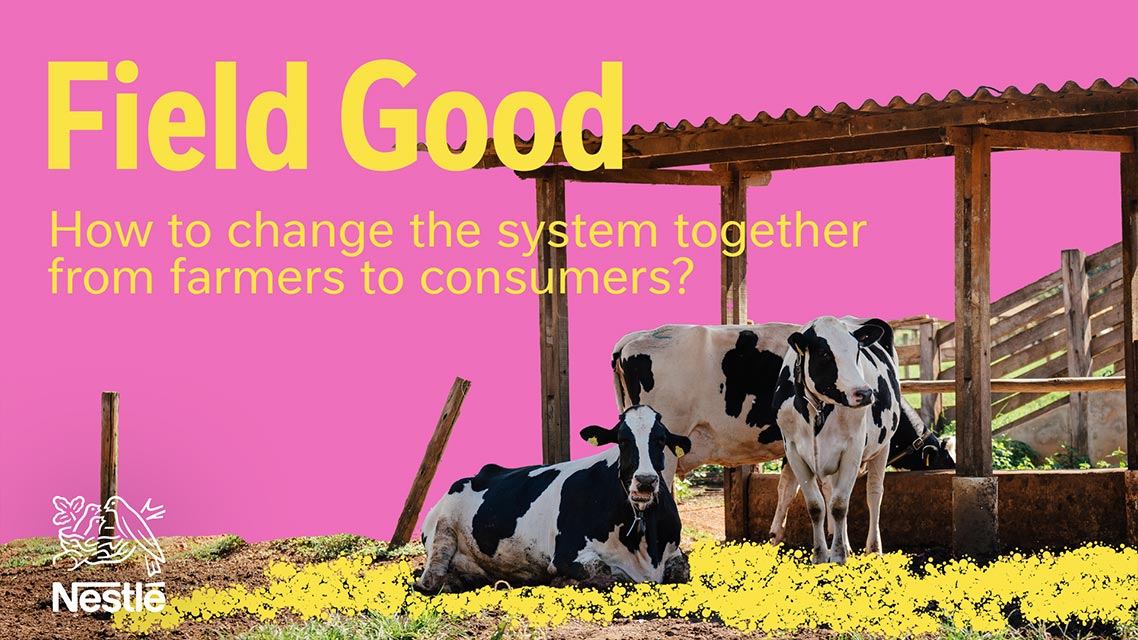
How to change the system together from farmers to consumers?
Changing how food is produced takes more than action on individual farms. It needs farmers, researchers, businesses, governments and consumers to work together.
Brazilian dairy farmer Cinthia Larissa joins Rafael Tonucci, a researcher at Embrapa, the Brazilian Agricultural Research Corporation, to explore how this can happen. Cinthia co-manages Fazenda Marinho São Lucas with her husband, Lucas, combining her business background with a passion for data. During her first year as co-manager, it became the first net-zero farm in Nestlé’s program to reduce green house gas emissions in Brazil. This episode explores:
- How farm data and shared standards can help measure progress
- Why research and knowledge exchange matter for putting regenerative agriculture into practice
- How consumers can contribute to a more sustainable food system
- How public policy and collaboration can help extend change beyond individual farms
Through Nestlé’s Nature por Ninho program, Cinthia has received training and support to adopt regenerative practices. Her story connects the everyday decisions of running a dairy business with the wider changes needed across the food system.
Listen on: Apple Podcasts Spotify YouTube More
This transcript may have been edited for clarity
Host: You’re listening to Field Good, a podcast by Nestlé. In each episode, we dive into the world of regenerative agriculture. Farmers and experts share their stories and experiences. A change is happening, let’s talk about it.
Welcome to Field Good. Every link in the chain matters. In this last episode, we're laying the final stone of our reflection on regenerative agriculture: how to change the system together, from farmers to consumers.
To unpack this topic, we're traveling to Brazil to speak with Cynthia Larissa, manager of the Marinho Farm, and Rafael Tonucci, a researcher at Embrapa, a public agricultural research company.
Before handing over to them, I'd like to share the story of Cynthia, a passionate woman who turns everything she touches into gold.
As the co-owner of a 162-acre dairy farm, Cynthia Larissa gets to manage a massive output of something she's passionate about: a core element of the food supply chain that she extracts every day from every living being on her farm. No, not milk. We're talking about data.
Cynthia never envisioned herself as a dairy farmer. She knew she wanted to become a business owner. Cynthia's meticulous data management and analysis is one of the biggest keys to her farm's success. Her farm is becoming the first net-zero farm in Nestlé's program to reduce greenhouse gas emissions.
Cynthia grew up in a dairy farming family in central Brazil. She discovered her passion for entrepreneurship during her university studies in accounting and business. It was also around this time that she met her now-husband, Lucas Schmidt, who co-manages the farm with her.
In 2024, she joined Lucas as a co-manager of Fazenda Marinho São Lucas, the farm originally purchased by Lucas's father in 1992. It was the perfect opportunity for Cynthia to leverage her business background to professionalize the administration of the farm.
The milk from Cynthia and Lucas's farm is used in three Nestlé products: infant formula, Ninho powdered milk, and Moça condensed milk. And as Nestlé suppliers, they were able to join the company's Nature by Ninho program, where they found training and support to implement regenerative agriculture techniques.
In addition, Cynthia took part in the Força da Moça do Campo initiative, which seeks to empower women in dairy farming to become stronger leaders and decision-makers on their farms.
After Cynthia joined the farm's management, several indicators began to show visible improvement. She started closely following every stage of the operation. Indicators for quality, productivity, organization, and people management improved even further, reflecting the direct impact of a more technical, data-driven administration.
While Cynthia and her husband were able to transform their business thanks to support and training from Nestlé, she adds that much more support is needed on the public policy side to drive meaningful change in the food production system at scale.
Cynthia likes to emphasize that transitioning to regenerative agriculture techniques is not purely about altruism. She's passionate about running a successful business and watching her on-the-ground changes drive her ROI. She's also grateful that she's able to improve animal welfare, create a healthier environment, and feed the next generation.
Thanks to her determination and love for her work, Cynthia has managed to create a model farm, a true achievement.
To wrap up this podcast series, Cynthia chats with Rafael Tonucci, a researcher at Embrapa, a public agricultural research company. Let's listen in to their conversation about how collaboration, science, and shared standards can help scale regenerative agriculture.
Rafael Tonucci, Researcher, Embrapa, the Brazilian Agricultural Research Corporation: Hello Cynthia, how are you? You're the manager of Marinho's Farm in Silvânia, which is one of the top performing farms in Brazil. You are also in the Net Zero program. What enabled you to reach this level, and what was the role of the local or regional policies?
Cynthia Larissa, Dairy Farmer: I believe this result came primarily from our vision of the future. We have always been open to change, to always improving. So we always wanted to produce more, efficiently and with more sustainability. Regarding public policies, we have a program called Mais Leite Saudável (Healthier Milk). It acts through tax incentive mechanisms, and it does contribute to development, although I still see that it needs to be improved to be able to serve other producers in different realities.
Rafael: And what do you think about the Nestlé's role in this?
Cynthia: Nestlé played a very important role for us because they were the ones who encouraged and supported us through programs, they developed themselves, which work on environmental sustainability, economic sustainability, and social part. This partnership made all the difference in our production practices, in animal welfare, and for us to have even more responsibility in the field in our production.
Rafael: I know that to ensure the smooth running of your farm, you collect a lot of data, okay? Do you think that having a common standard would help ensure the progress of every farmer?
Cynthia: Yes, Rafael. I believe that a standard will help a lot to accelerate the progress and growth of other farms. In fact, we have a strong sense of community. Producers don't usually see themselves as competitors. We always seek to share experiences that help each other.
I have an example that happened with us: a producer who is our friend noticed that our corn crop was looking better and stronger, and he asked what we were doing, right? And that's when we explained to him the whole process of regenerative agriculture. He started applying it on his own farm, and today he's already starting to reap the good results of that change.
Rafael: Yeah, I do think this is the most amazing thing of doing this kind of job, because we grow a fruit or a management in our farm, and then we can multiply to the others. Okay, you're doing better than me, so what is he doing better than me? What can I do to improve my production and be as good as him? So I think this is the most amazing results we can achieve with this kind of partnership.
Cynthia, in your opinion, what's the role of brands and consumers in creating a more viable industry?
Cynthia: As a consumer, I increasingly look for foods and brands that are committed to sustainability. I believe they have this power, this role of offering more sustainable options. And Nestlé, for example, has products that carry an affective memory with consumers. For instance, powdered milk, Ninho, and Moça condensed milk. These are products that are Brazilian favourite, right? And in your opinion, Rafael?
Rafael: So Cynthia, I think in my opinion, I completely agree with you. I also, as a consumer, I normally choose for products or brands that care with sustainability and that care with the environment and everything. Not only because it has like a recycled box or anything like that, but it cares from the field to the consumers.
Cynthia: Collective action is essential to advance these issues. How do you think we can ensure that all partners work together?
Rafael: This is, I think, one of the toughest tasks we have, because to make everyone work as a group, working together to achieve the same goal, it isn't easy at all. So my point here is that we have the industry may push us like, okay, we need you to do that, and also the government, and also the research. We all need to be on the same page. Again, it's not an easy task to do, but I think we are going in this direction.
And I really think this Nestlé program that guides us in this direction is one of the main great results we will have, a focus on that.
Cynthia: You are a researcher at Embrapa working with regenerative agriculture issues. Does your research act as a bridge between all stakeholders?
Rafael: This is also a tough question. To work with all the parts, it is quite difficult, but we try. Our main focus here, and regarding regenerative agriculture, we work much more with the farmers. We work with healthy soils, soil health, and cover cropping, different topics in the research.
When we have like the opportunity that Nestlé gave us to put all our boxes, I would say that way, soil and cropping and milk production and milk quality as a whole in a farm, this like a, I would say, the perfect storm, but I would say that it is a good storm. So we can do everything in a farm as we are doing with you and other Nestlé's and other farmers. I think we have six or seven of the technologies all over the country. You have it in different parts of the country, the main producers that Nestlé has in different parts of the country.
And it is great because I can test my research in real life. Because when you do it in an experimental field, we have results, good results, we can publish a paper, okay, we can put in scientific point of view. But again, as I mentioned earlier, for me, the greatest achievement is to change your reality, not the scientific community reality. And this opportunity we have to put all our research together in a farm, in different farms, and test it and see that it works, it's a great opportunity we have.
Cynthia: The government obviously has a role to play, but so do consumers. Is your scientific research an effective way to convince them?
Rafael: I think we are doing our best. As a researcher, I try to convince both the government that this is an important issue we have to study, and convince the farmers to trust us, because they can rely on our research. So this is what we're trying to do. And again, I will back again what you said earlier in your comment that Embrapa helped you a lot doing all the achievements you are having now.
You will be like a benchmarking for me to convince the government that, okay, look at the results we're having here, and see how important it is to work this kind, to develop research and to research this kind of technologies. We are changing the reality of the farmers. I think this is really important. And I use you as a model to convince the government and also other farmers: 'Oh, in Silvânia, Goiás, we have a great experience, and we are changing the reality, and we are increasing milk production, and they are producing a better milk with milk with higher quality. Why don't you do this?'
So we try to convince them by showing them not only the results we have in our research, but also the results we are having when we apply these results in the field and the farmers. So I think we're doing it. Again, it is not easy to convince everyone, and I'm quite sure not everyone will be convinced by me or by Embrapa in general, but it is important. And I think we are doing a great job and we are going in the right direction.
Cynthia: Rafael, regarding the quality of the food, is it a determining purchasing factor for customers?
Rafael: Yes, I think it is. As I mentioned earlier and also you mentioned, we also agree with this kind of things. When we are buying any kind of food or anything, we do look for quality. So in my opinion, quality is like one of the main drivers to guide the consumers to have it, in my opinion.
In an ideal world, what would you like to see implemented for the democratization of regenerative agriculture?
Cynthia: In an ideal world, I would like to see all producers increasingly engaged with environmental issues, adopting regenerative practices. And for this to happen, it is very important that we further strengthen our partnerships between producers, entities, and companies, because through this, we can promote more knowledge and incentives.
So this union is very strong and I believe this is what will increasingly bring us care for the environment and the economic growth of producers as well, which is important. And for you, Rafael, what do you think?
Rafael: Again, in the ideal world, it's hard to think on it, but I do believe that as you mentioned, everyone has access to that thing. I wish every farmer could be assisted by someone or animal scientist, or agronomy, or a vet, anyone that has the principle and know the principles of regenerative agriculture. Because again, I think this will change how we produce it, and focus on that, we can change it in a better way to have a more sustainable production, milk production, or and everything.
So for me, the ideal world where everyone has to have the opportunity you have and other farms has to be followed, to be guided for someone who knows this kind of technologies. And as you mentioned, could have their reality changed as you have. I think this is the ideal world for us to go in this direction of regenerative agriculture, and that will guide us to a better future, I think. Bye-bye Cynthia, it was nice to talk to you, have a nice chat here. Thank you.
Cynthia: Obrigada, gente. Thank you.
Host: Thank you Cynthia Larissa and Rafael Tonucci for sharing your knowledge and experiences for this last episode of Field Good. To learn more about Nestlé's commitment to scale regenerative agriculture and what this means for their brands, visit nestle.com. See you soon.
END OF TRANSCRIPT
Key terms explained
Regenerative agriculture
In line with the Sustainable Agriculture Initiative Platform, Nestlé defines regenerative agriculture as an approach to farming, which aims to conserve and restore natural resources, primarily soil, as well as water and biodiversity, while capturing carbon in soils and plant biomass and to support farmers' livelihoods. Examples of regenerative agriculture practices include reduced tillage and agroforestry. More information is available in our Nestlé Agriculture Framework (pdf, 19Mb).