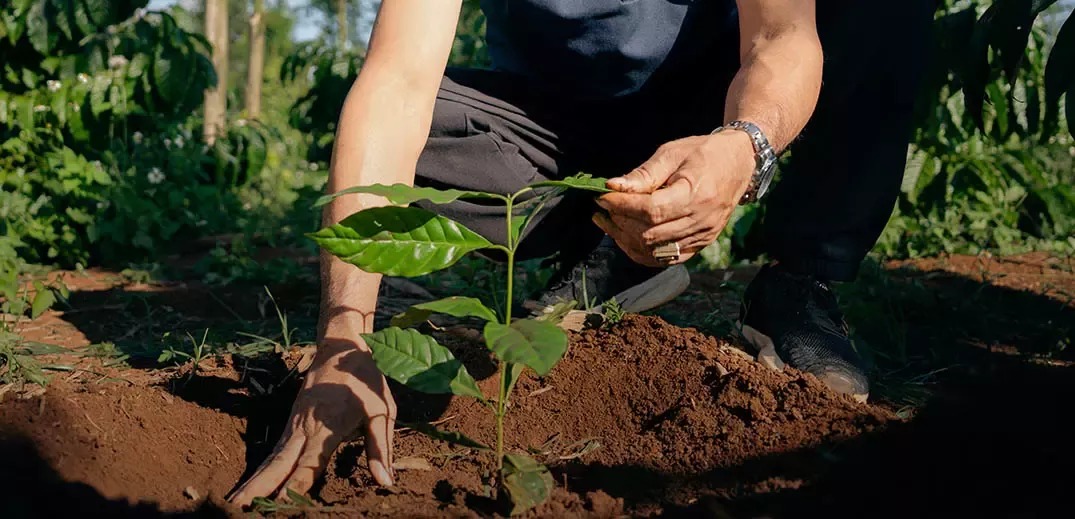
As coffee trees age, they naturally become less productive and may become more vulnerable to climate change, further reducing yields. Nestlé therefore helps farmers renovate their plots with new coffee varieties that are more resilient to climate change and disease. In 2025, Nescafé distributed 20.3 million coffee plantlets to farmers.
In the same year, 94.3% of Nescafé coffee was responsibly sourced,1 meaning green coffee lots were traceable to identified groups of farmers and independently certified or verified as being produced in alignment with Nestlé's responsible sourcing requirements.
Beyond farming, the 2025 Nescafé Plan progress report also covers manufacturing, distribution and packaging across Nescafé's value chain. Within Nescafé's operations, the three main sources of carbon emissions are manufacturing, logistics and packaging. In 2025, 98.6% of the electricity used in Nescafé coffee manufacturing sites was renewably sourced, contributing to GHG emissions reductions.
The report also highlights Nescafé's efforts to strengthen human rights in coffee-growing communities through due diligence, supplier capability building and partnerships to expand impact on the ground.
In 2025, Nescafé co-developed the Nescafé Plan Child Protection Framework with its strategic partner, Terre des Hommes, to strengthen child protection systems in coffee supply chains. In 2026, Nescafé extended its partnership with the International Labour Organization (ILO) to advance labor rights in coffee supply chains.
"We believe in supporting systems that protect children today and help secure better opportunities for the future", said Roy Tjan, Child rights and business global advisor, Terre des Hommes. "Our partnership with Nescafé reinforces this belief by integrating the company's child protection efforts on the ground with the community and public State systems already in place."
"Evidence-based and participatory approaches are essential to achieving lasting improvements in working conditions," said Ockert Dupper, Global Programme Manager, Vision Zero Fund, International Labour Organization. "Partnerships such as the one with Nescafé play a key role in enabling these approaches to be implemented effectively and at scale."
Through its integrated approach, the Nescafé Plan aims to help build a more resilient coffee supply chain for the future.
Summary
The 2025 Nescafé Plan progress report shows that Nescafé sourced 53% of its green coffee from farmers adopting regenerative agriculture2 practices in 2025, a significant achievement, while broadening its reporting scope across the coffee value chain. Last year marked 15 years since the inception of the Nescafé Plan, which aims to make Nescafé's coffee value chain more resilient3 to climate change and to foster meaningful environmental and social outcomes through long-term investment.
1 For Nescafé, responsible sourcing means coffee lots are traceable to the first aggregation entity forming the farmer units where the coffee was grown, and are independently certified or verified as produced in accordance with sustainability standards validated as equivalent to our Nestlé Responsible Sourcing Core Requirements. This involves applying our environmental and human rights requirements at the different stages of our supply chain. Examples of these requirements include that land and resources of Indigenous peoples and local communities are respected and that no deforestation and no conversion of forests and other ecosystems occur in our supply chain. Our Reporting Scope and Methodology for ESG Key Performance Indicators document provides details and can be found in the Nestlé non-financial statement 2025.
2 In line with the Sustainable Agriculture Initiative Platform, Nestlé defines 'regenerative agriculture' as an approach to farming which aims to conserve and restore natural resources, primarily soil, as well as water and biodiversity, while capturing carbon in soils and plant biomass, and to support farmers' livelihoods.
3 As defined by the United Nations Food and Agriculture Organization (FAO), resilience is the ability to prevent disasters and crises as well as to anticipate, absorb, accommodate or recover from them in a timely, efficient, and sustainable manner. This includes protecting, restoring, and improving livelihoods systems in the face of threats that impact agriculture, nutrition, food security, and food safety.
Media inquiries
Phone: +41 21 924 2200
Email: [email protected]