
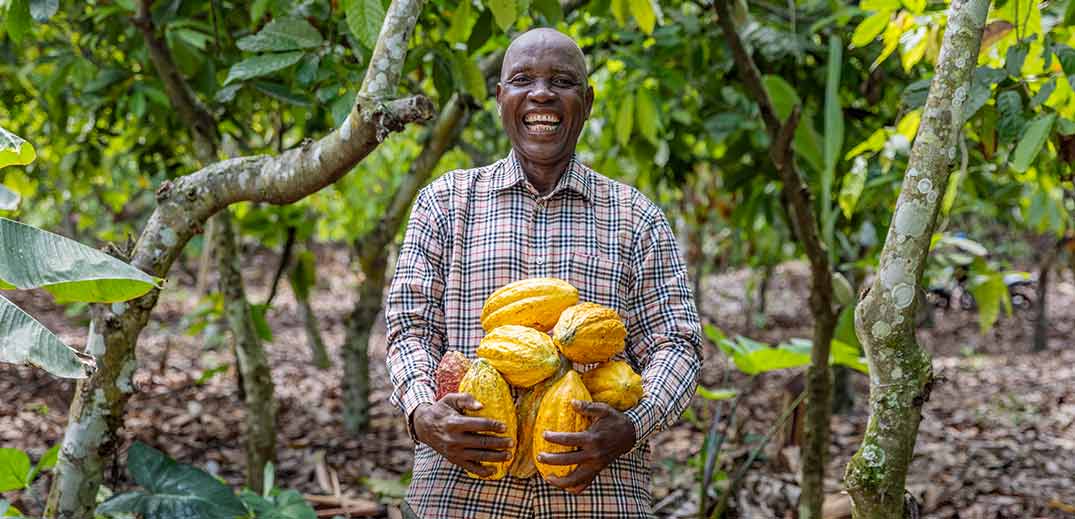
In the village of Guéwa, in Côte d'Ivoire, cocoa farmer and father-of-seven Nahoua Sekongo has a new way of describing his family's life: "Now, I harvest more and waste less, increasing my income in the process."
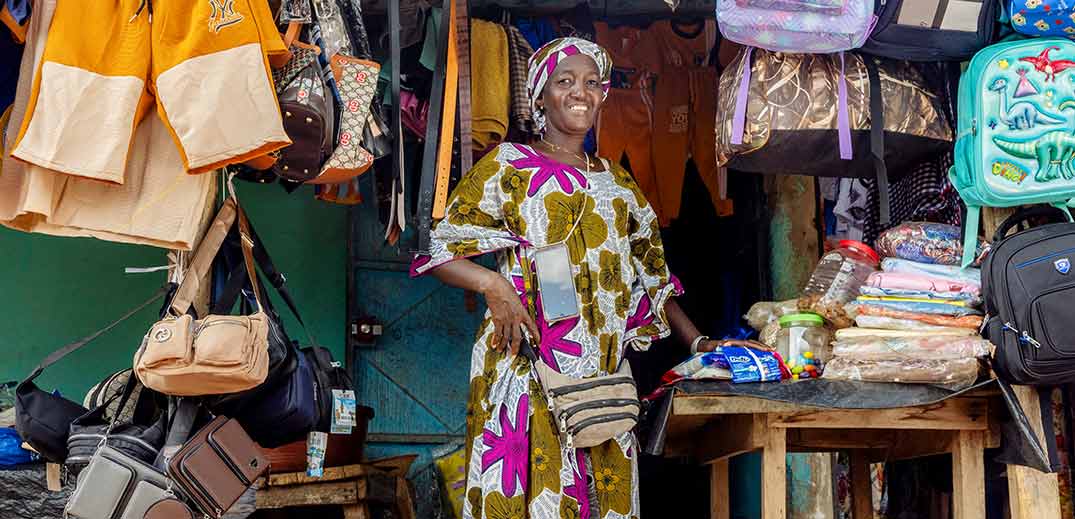
His wife runs a growing village shop, funded by savings and a small loan. His children have books and food for the week. The family has invested in livestock as a financial safety net. "It's about security," he says. "We are building something for the future."
It wasn't always this way. Like thousands of cocoa-farming households across West Africa, Nahoua's family once faced the reality that defines life for so many in the sector – a persistent gap between what the land earns and what a family needs to live with dignity. "Before, we were surviving season to season," he explains.
What changed was a program designed to do more than improve yields. Nestlé's income accelerator program (IAP) works with the whole household – not just the farm – to help build the farmer’s resilience to climate challenges.
Nahoua is one of ~45 000 cocoa-farming families now participating in the program in Côte d'Ivoire and Ghana. His story is the reason the program exists.
Building on 15 years of learning
The IAP was built on the foundation of the Nestlé Cocoa Plan, launched in 2009, which over 15 years has engaged more than 175 000 farmers across 11 origin countries. It gave us deep roots in these communities – the relationships, the supply chain knowledge and, crucially, the trust. But we recognized that training and certification alone were not moving the needle on living incomes fast enough.
So in 2020, we piloted a different model with 1 000 families: conditional cash incentives paid directly to both the farmer and their partner for measurable improvements on the farm and at home. The premise was simple: building the foundations for more resilient cocoa farming (or supply chain).
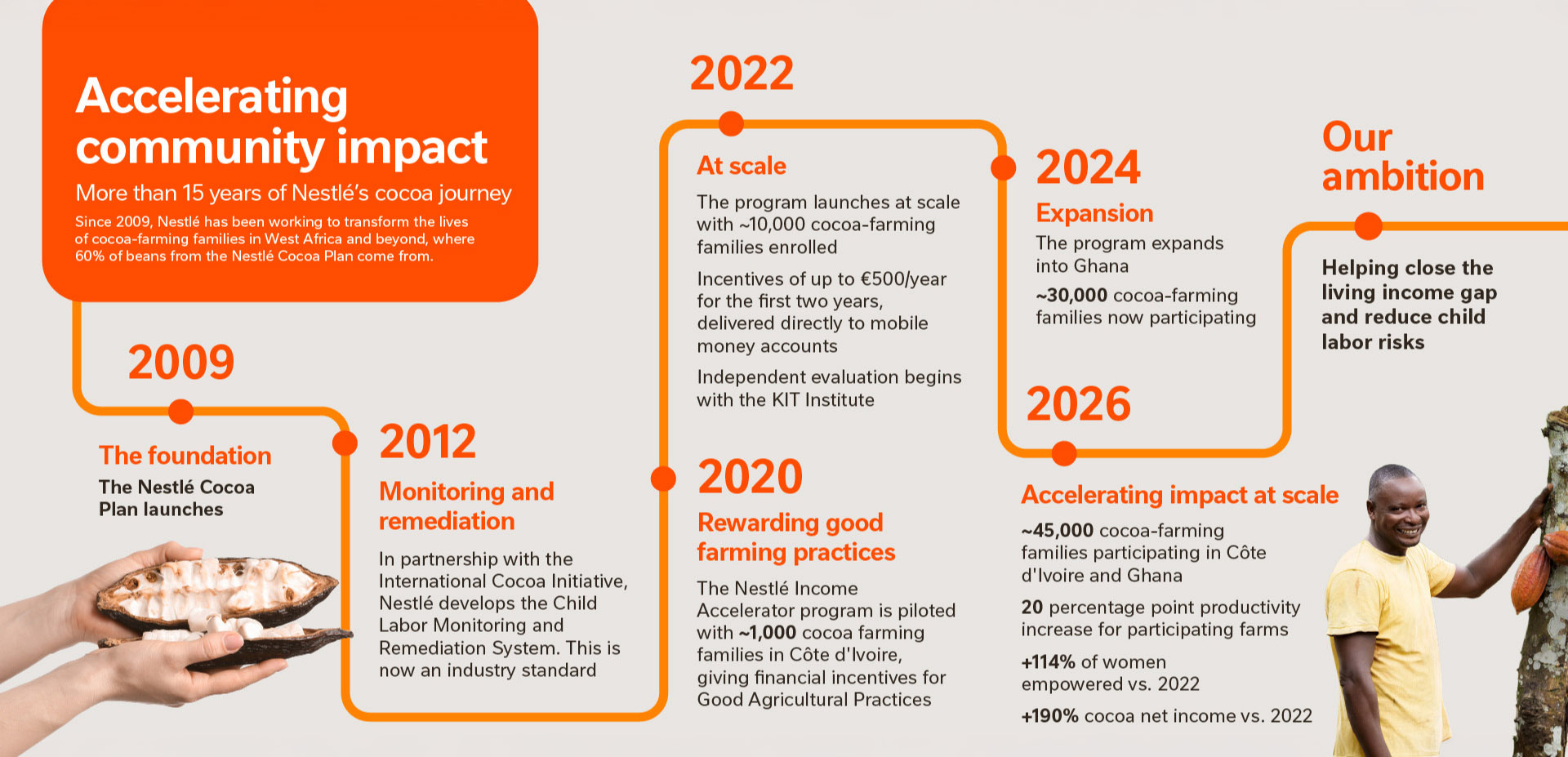
Source: Nestlé Income Accelerator Progress Report - KIT Institute - June 2026. Visit Nestlé Cocoa Plan website to access the summary report or download the infographic (pdf, 400Kb)
How the program works
Families can earn up to €500 a year in the first two years and then €250 per year, split equally between two areas of support – one focused on the farm, one on the household.
- On the farm, the program focuses on Good Agricultural Practices and agroforestry. Pruning groups work alongside farmers to help improve tree health and boost yields, while forest and fruit tree saplings are planted for shade. It’s a practice which is part of the regenerative agriculture approach to farming that aims to improve soil health and biodiversity, while benefiting the farmers with fruit and timber they can use or sell.
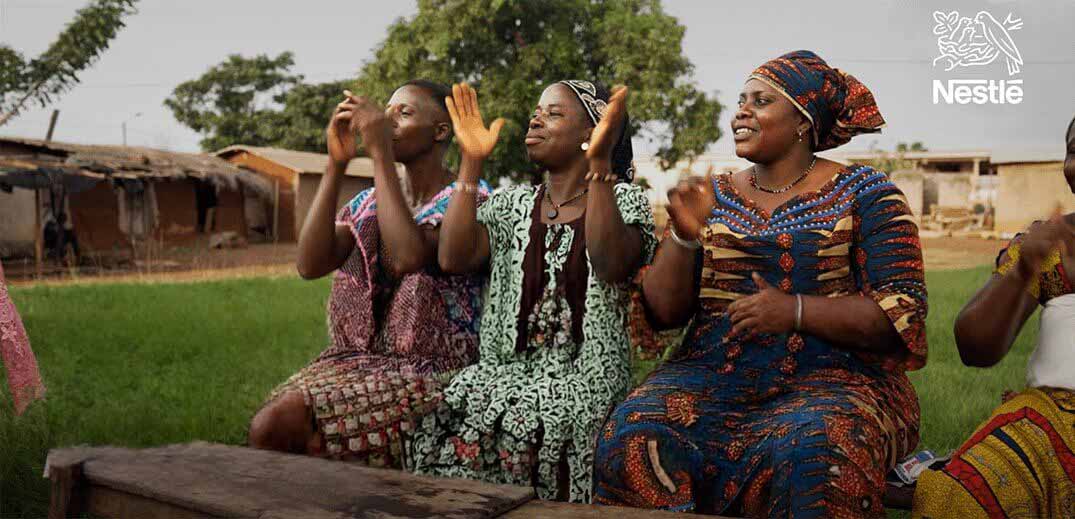
- In the household, the program incentivizes school enrollment for all children aged six to 16, and establishes Village Savings and Loan Associations in every participating village. These groups give women access to micro-loans and financial training to start businesses beyond the farm. Gender Action Learning System (GALS) sessions go further, helping women build a business vision alongside their husbands. This shared process helps reduce household tension and strengthens decision-making together.
What makes the IAP fundamentally different is that it is not a farm program – it is a family-centered program. Payments go separately to the farmer and their partner, giving many women their own mobile money accounts for the first time. The farm and the household are treated as a single, interconnected unit, because lasting resilience can only be built that way.
The impact of the program is measured by the KIT Institute and published in the annual report. During the severe 2025 climate shocks, productivity among the 10 000 Côte d’Ivoire families who have joined the program since 2022 grew by 4% (vs. 2022). At the same time, non-participating cocoa-farming households in the same districts but different cooperatives and communities saw a 16% decline. This 20-percentage-point performance gap demonstrates true resilience.
Additionally, women in the program are 113.9% more empowered,1 and community savings have grown by 540%.
We are realistic about this. After four years, we have seen this approach deliver impact, but not uniformly and with room for improvement. But the direction is clear, and we continue to adapt: simplifying the incentive structure on the KIT Institute's advice, introducing composting and weeding pilots, deepening support for women's income diversification. Success comes from listening, adapting, and crucially, sharing what you learn.
An open model for the whole industry
We decided early on not to trademark the income accelerator. Instead, we publish our KIT Institute evaluations openly every year – missteps included – to inspire industry-wide change.
To take this a step further, we’ve teamed up with four partners to launch the TogetherCocoa Foundation. It’s a way to combine forces across the industry and continue Nestlé’s work to help close the living income gap.
We will continue to expand the Nestlé income accelerator program while adapting our approach, including reviewing our ambitions over time as the TogetherCocoa Foundation scales.
Nahoua Sekongo can now talk about the future with confidence. The challenge, for Nestlé and for the wider industry, is making that future possible for more farming families. Read the full 2026 IAP Progress Report (pdf, 2Mb)
Resilience
As defined by the United Nations Food and Agriculture Organization (FAO), resilience is the ability to prevent disasters and crises as well as to anticipate, absorb, accommodate, or recover from them in a timely, efficient, and sustainable manner. This includes protecting, restoring, and improving livelihood systems in the face of threats that impact agriculture, nutrition, food security, and food safety.
Good agricultural practices
The Rainforest Alliance defines Good Agricultural Practices (GAPs) through their Sustainable Agriculture Standard as a comprehensive, risk-based framework for farming that aims to improve livelihoods, protect biodiversity, and enhance productivity.
1 The Women Empowerment Index (WEI) is an aggregate of three scores: women’s access to resources; participation in decision making (about revenues and investments from income sources, household small and big expenditures, and children’s schooling and health); and access to an enabling environment (group memberships).