

On Thursday, February 13, 2025, we announced our full-year results.
Watch the press conference:
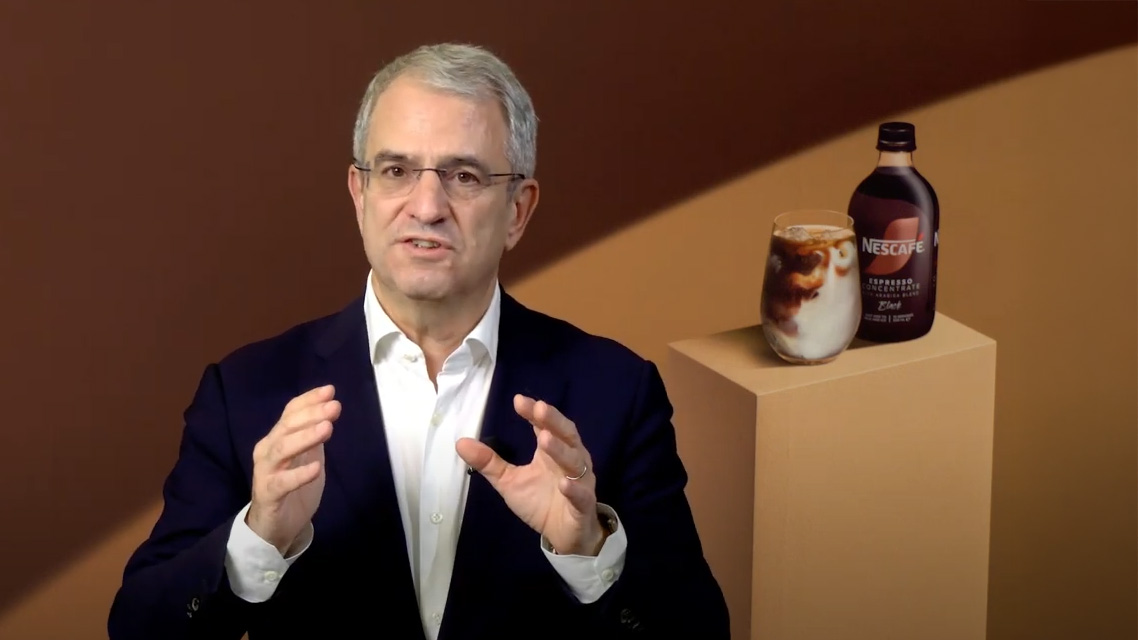
On Thursday, February 13, 2025, we announced our full-year results.
Watch the press conference:
This transcript may have been edited for clarity
David Hancock, Head of Investor Relations, Nestlé S.A.: Good morning, and welcome to Nestlé’s Full year 2024 results conference call. I am David Hancock, Head of Investor Relations and I am joined today by Laurent Freixe, CEO, and Anna Manz, CFO.
Before we get started, please take a moment to review the disclaimer.
Let me quickly take you through the agenda. After the key messages, we will review the 2024 financials, share details of our strategic progress and look at 2025 guidance, before summarizing and then moving to Q&A.
With that, I will hand over to Laurent.
Laurent Freixe, Chief Executive Officer, Nestlé S.A.: Thanks David and good morning to all. Let me start with four key messages regarding 2024 and our outlook.
First, we delivered 2024 results in-line with or slightly better than our latest guidance provided in October, both on topline and on profitability, and cash flow was strong.
Second, we have given formal 2025 guidance this morning. This is unchanged versus the previous outlook despite the recent commodity price moves.
Third, we are stepping up investment to accelerate category growth and improve market share performance. This is funded by our CHF 2.5 billion cost savings program called Fuel for Growth. We will provide some more details on progress today.
And finally, we have moved quickly to put the organization in place and align our teams to deliver our plan.
We had a solid finish to 2024, and this gives us a good base as we move into 2025.
It is important to keep in mind that we are on a journey, and it will take time until we are firing on all cylinders. But things are changing, and changing fast.
With that, I will hand over to Anna to take you through the 2024 results.
Anna Manz, Chief Financial Officer, Nestlé S.A.: Thank you Laurent, and good morning. I am going to cover our performance in 2024 and the implications for 2025.
We delivered 2.2% organic sales growth with RIG of 0.8% and pricing of 1.5%. Sales were also negatively impacted by foreign exchange movements due to the strengthening of the Swiss Franc.
Several factors shaped our sales delivery for the year: Consumer demand softened in 2024; sentiment has stabilized but remains fragile. Consumer hesitancy towards global brands in Zone AOA had a negative impact of 40 basis points on the Group’s organic growth. The actions taken to reduce customer inventories in the second half of the year had an additional 20 basis point impact on growth. Pricing was lower in 2024, reflecting a reduction in input cost inflation across most categories and a return to a more normal promotional environment.
If we look at the quarterly movement of sales, you can see how these factors impacted growth by quarter. The sharp reduction in Q1 RIG was largely due to the U.S., where growth in Frozen food was strongly negative and, in addition, we had temporary supply constraints in our VMS business.
All quarters were impacted by soft consumer demand and consumer hesitancy toward global brands in Zone AOA. Inventory reduction actions impacted Q3 and, to a lesser extent, Q4.
As cocoa and coffee prices increased, we took incremental pricing in the third and fourth quarters.
We delivered 17.2% UTOP margin, down 10 basis points versus 2023 and flat in constant currency terms. Gross profit margin increased 80 basis points. And we stepped up advertising and marketing investments by 40 basis points. I will explain this in a minute.
We saw a 50 basis point increase in administration expenses. This is due to higher labor costs, the appreciation of the Swiss Franc and increased growth investments, particularly in digitalization.
To put that labor cost increase in context, our salary inflation was about 3% in 2024, which benchmarks well against a global weighted average for the markets where Nestlé operates.
The 80-basis point improvement in gross profit margin was driven by pricing, portfolio optimization and net input cost reduction. That net input cost reduction is the combination of commodity price increases offset by existing efficiency programs.
In 2024, we delivered over 1.2 billion CHF of efficiencies, predominantly benefiting gross profit margin, with 500 million coming from recipe reformulation and the remainder from enhanced technology programs in our plants and logistic network re-design.
As you can see, gross profit margin declined sequentially in the second half as we saw higher commodity costs, primarily in cocoa and coffee. That is continuing into 2025.
Pricing, efficiencies and strategic revenue management actions will allow us to offset most of the absolute increase in cost of goods sold. Nevertheless, we expect gross profit margin in percentage terms to be lower for 2025.
As we told you at our Capital Markets Day, going forward we will invest more in growth. This includes: taste, quality and innovation; price; distribution; and advertising and marketing - depending on our diagnosis of where we need to win with the consumer.
Investment will be focused behind the most attractive opportunities and where we have robust execution plans.
Specifically on advertising and marketing, we expect to reach 9% of sales by the end of the year, as we previously guided.
That means that for the full-year 2025, the increase should be at a similar level to the 40 basis points increase in 2024.
This slide shows how gross profit margin dynamics and growth investments flowed through to UTOP, with margin down sequentially in the second half.
Looking forward, given what I have told you on gross profit margins and the timing of investments and efficiencies, for 2025 we expect a further decrease.
Let me give you a brief summary of the key factors shaping the performance of our segments this year.
In Zone North America, our growth was disappointing. Consumer demand was weak, particularly at the lower end of the income spectrum. We lost share in Frozen food and we were held back in Coffee creamers by capacity constraints for most of the year. Our actions to improve competitiveness in these underperforming cells have not yet translated to a meaningfully improved growth trajectory. Despite this negative growth, the Zone improved its UTOP margin through mix management and disciplined cost control while stepping up investments for future growth.
Zone Europe delivered solid growth, with improving market share trends. As we shared on our 9-month call, Q3 was impacted by de-listings linked to temporary customer challenges to price increases, as well as a slowdown in Turkey. In Q4, growth improved as we got back on shelf. We are taking more price in 2025, so this this may give rise to more customer challenges. Margin improvement in Europe was strong, supported by portfolio management.
Zone AOA delivered positive RIG despite multiple macro headwinds. Consumer hesitancy toward global brands in some markets remained a drag through the year, but it is now in the basis of comparison as of Q1. The fourth quarter slowdown in RIG was partially linked to actions to reduce customer inventory.
In LATAM, growth was driven by price. The actions taken to manage customer inventory reduced growth in the third quarter, but the fourth quarter bounced back, driven by additional pricing in Confectionery and Coffee, across most markets.
In China, a deflationary environment meant pricing opportunities were limited. Despite that, the Zone delivered solid RIG-led growth thanks to continued innovation, with strong performance in RTD coffee and E-commerce.
Nestlé Health Science did exactly what we said it would, with the second half of this year seeing growth accelerate. We have started to see an improvement in market share trends in VMS and are growing slightly ahead of the category, a category which is growing in high single-digits. The growth leverage delivered a step up in margin.
Nespresso’s solid RIG-led growth was largely driven by the U.S. Europe posted close to flat growth and remains an area of focus. The broader Nespresso ecosystem, including Starbucks by Nespresso, adds another 100 bps to growth.
By category, the Group’s growth was driven by Coffee, Confectionery, PetCare and Health Science.
Coffee delivered mid single-digit growth, led by soluble and RTD.
Growth in Pet was driven by RIG. As expected, pricing reduced, but has started to stabilize a little more in the fourth quarter. I have already commented on Health Science. Nutrition posted positive growth, with continued momentum for NAN.
Prepared dishes and cooking aids was held back by the performance of Frozen Food in the U.S. Milk products and Ice cream was impacted by weakness in Dairy and Coffee creamers in the U.S.. Confectionery growth was driven by pricing. KitKat globally, and Garoto in Brazil were the key drivers here.
Turning to profit, just a few things to note. Margins in Coffee and Confectionery were primarily impacted by higher input costs.
In Prepared dishes and cooking aids, the margin increase was supported by higher gross profit margin driven by portfolio optimization and efficiencies.
Milk products and Ice cream posted lower margins, following higher advertising and marketing investments and reduced growth leverage.
Water saw a margin reduction, impacted by supply constraints.
Now let’s talk about what sits below UTOP.
The first item to highlight is restructuring. This came in significantly lower than the CHF 700 million we had expected at half year as the implementation of several projects was delayed.
The second item is net financing costs, which increased with higher average net debt and an increase in interest rates.
Finally, our reported tax rate increased, mainly due to a write-off in deferred tax assets in the current year and the absence of favorable one-offs impacting last year.
To note, our underlying tax rate increased by 70 basis points to 21.9%, driven by higher tax rates in a couple of jurisdictions, as well as changes in the geographical and business mix of profits.
Next to underlying EPS.
I have already talked to the drivers of our operating profit and interest and tax.
The lower share count helped EPS growth, contributing 1.1% to underlying EPS, but this was more than offset by an adverse FX movement.
Working capital continues to trend downwards as we work to optimize our supply chain.
We will further optimize our working capital, but the improvement in 2025 won’t be of the same magnitude as 2024.
CAPEX as a percentage of sales decreased slightly in 2024 and is expected to trend down from here, as we are coming out of a period of elevated investment in new capacity in PetCare and Coffee. We are now shifting our focus to efficiencies and getting more out of our asset base.
When you adjust for the sale of the Prometheus stake in 2023, free cash flow improved by 0.9 billion to CHF 10.7billion.
The key drivers of this improvement were a reduction in working capital, lower tax and lower cash restructuring costs.
For 2025, we expect cash flow to be below the level of 2024. While we will benefit from lower CAPEX, we expect a smaller improvement in working capital and higher restructuring costs as we step up our cost savings program.
Net debt increased largely due to the 12.2 billion returned to shareholders, through the share buyback and dividend payment.
In addition, there was a 2.1 billion adverse impact from changes in FX rates.
Our net debt to EBITDA ratio is towards the top end of our range.
Return on invested capital increased reflecting improvements in working capital, as well as lower restructuring costs.
And with that I will hand back to Laurent.
Laurent Freixe, Chief Executive Officer, Nestlé S.A.: Thank you Anna. I want now to turn to what we are doing to accelerate. This will build on the frame we set out at the CMD, bringing more color and detail.
At the CMD, we set out how we plan to accelerate performance and transformation, by driving operational excellence, by unlocking the full portfolio potential, and by strengthening our foundations. With this reminder, let’s look at what we have been doing to accelerate Nestlé.
We started with sharpening the strategy, building on our nutrition, health and wellness foundations. And we put in place the organization to set us up for delivery.
We simplified the Zone structure, moving from 5 zones to 3, reorganized Waters and Premium beverages into a global standalone business, and I took digital and sustainability to report directly to me.
From the outside, these changes may sound like simple changes to our reporting segments. But these changes are not at all trivial – ultimately, they impact 270,000 people. We are not only changing the way we report – we are changing the way we work.
We are not only changing the way we report – we are changing the way we work.
I am really pleased that we executed this in a matter of a couple of months, and I want to thank our teams for this. With the plan and with the organization in place, we need to make sure everyone is aligned behind the execution.
In the last weeks, we have cascaded down the strategy across the organization through what we call our OMP – our operational master plan. It sets out in detail the actions and the KPIs behind the objectives, with clear targets and owners against each. And we have started to track progress through monthly operational reviews.
You can see the strategic virtuous circle we use internally as our strategic framework.
This picture - annotated with the OMP actions - is something you will find on Nestlé desks around the world.
There’s a lot that sits behind this. It starts with efficiency and productivity – because this is the fuel for the growth engine. Next is investing for growth, with appropriate impact so that we deliver growth with the right returns. It is important to reiterate here that we are not waiting until we have all the additional fuel from efficiencies before we start to invest.
This all leads to creating shared value - making sure we deliver that profitable growth in a long-term, sustainable way. I’m now going to talk to what we have been doing and what we will be doing in these 3 areas.
I will start with efficiency, the Fuel for Growth. As we showed at the CMD, the protection of our margin came more from reducing investment than increasing efficiencies.
We are now grasping the efficiency opportunity, with three key elements to our approach.
First, it is comprehensive and end-to-end. It is actually more than a decade since we thoroughly reviewed many key areas of spend like procurement and commercial spend, or the organizational structure of our functions. That is changing.
Second, we approach this in a coordinated way, with structured group-wide programs rather than ad hoc local projects. With that comes clear targets, with incentives linked to delivery.
Third, we are working in a data powered way, leveraging digital technologies and AI.
At the CMD, we announced a new three-year cost reduction program, which is in addition to existing annual cost efficiency initiatives. We have called this new program Fuel for Growth. We target, as you know, CHF 2.5 billion of cost savings by the end of 2027.
To date, over 300 million of the expected savings for 2025 have already been secured.
To bring the savings opportunities to life, I want to give a few examples starting with procurement.
With annual spend of over CHF 60 billion, we see lots of opportunities in this area. We are increasing the consolidation of our spend and doing it in a more systematic way. One example: we are currently moving from a centralized ingredient catalogue covering 50% of raw material spend to 80% of coverage.
In addition, we are leveraging AI tools to review invoices versus our contracts to identify and recover value leakage. In the last 3 months, we have assessed approximately 3,000 of our largest suppliers covering over 80% of our total spend. This has allowed us to identify historical inconsistencies between contract and invoice that can be recovered, providing a one-time benefit. It also allows us to find potential opportunities to reduce spend on an ongoing basis.
The other big bucket of savings opportunity is operational efficiency. In manufacturing and logistics, digitalization is unlocking multiple efficiencies in areas such as plant maintenance and smart energy usage.
We are also looking at our operating models with an end-to-end view across our functions. This includes spans and layers, central vs local, shared service centers, and automation. For example, our in-market finance teams spend today 40% of their time on data compilation, report updates and ad-hoc analyses. With today’s technology it should be less than 5%. This is a cost saving, but it also creates organizational agility and improves the experience of our people.
And there are many opportunities like this across all functions.
That is how we are creating the fuel. Now, let’s look at how we will deploy it to accelerate growth.
As you know our mid-term ambition is to deliver 4% plus growth. To do that, we need to accelerate the category growth and improve our market share.
We have four main levers: expand our winners to reach their full potential, achieve more impact from innovation by scaling our big bets, build new growth engines and last but not least, address our underperformers.
I will dig into how we are progressing on these levers in some of our largest categories. But first I want to spend a moment specifically on our underperformers.
In 2024, we gained or held market share in approximately half of our business cells by number, but in less than half by sales value. The majority of that share loss is driven by 18 key underperforming cells.
We have assessed what gaps in our value proposition have driven the underperformance. Across most of the 18 cells, there is work to do on more than one dimension.
It is important to address the issues in the right order. For instance, there is no point in increasing marketing spend behind a product without taste preference or where we have the wrong pricing.
Overall, you can see we had the most work to do on value and visibility. We are investing to address those gaps and our progress is measurable. Let me give you a couple of examples. First, on product superiority, look at Wyeth China.
Illuma had lost its premium-ness and differentiation vs. competitors. We are addressing that through science-based innovation with HMOs. Along with improvements on distribution, this is starting to drive an improvement in share.
Next is U.S. frozen pizza. You all know that a key reason for our loss of share has been the price gap vs our major competitor. We have now lowered prices, as well as launching new products. We have begun to see evidence of success and have some early gains in volume share.
Overall, we are still early in addressing many of our issues, but we are moving, and there are some encouraging signs.
Now, let’s take a look at progress across some of our largest categories.
In Ready-to-drink coffee, annual sales today are around CHF 1 billion with double-digit growth. There is a lot of runway ahead as we expand beyond our current strongholds. We launched new markets in AOA in 2024, and we are doing the same in Europe and Latin America. The new launches are off to a strong start.
Coffee out-of-home represents annual sales of about CHF 2.5 billion with an objective to grow at 10%+ annually. We are leveraging all three of our unrivalled brands in Nescafé, Starbucks and Nespresso.
In coffee, beyond those, we have 2 innovation big bets. Nescafé espresso concentrate was launched in 2024 in Australia and resonated strongly. In 2025, we are expanding into 7 new markets including the U.S. and the U.K.. With Nescafé Dolce Gusto Neo we are rolling out to 6 new markets in 2025 and launching new machines in existing markets.
On underperformers, we have said before we need to revitalize Nespresso in Europe, by increasing availability and visibility.
Turning next to PetCare. Category growth slowed in 2024, but we continue to expect 4-5% in the medium term.
For Nestlé, we see a lot of opportunities: In Zone-AOA, we can be much larger than we are today. We are making a substantial investment in capabilities, particularly in route to market , innovation, and marketing. Growth accelerated to double-digits in the second half of 2024, and we are growing market share.
Therapeutics is already a business of over CHF 600 billion and growing strongly. To drive that further, we are expanding investment in science-based innovation and veterinary engagement and scaling up in D2C.
On innovation big bets, earlier this week we announced the expansion plans for our unique pyramid-shaped wet cat food. In 2025, we will expand nationwide across the U.S. and in 15 fifteen markets in Europe.
Nutrition Health and Wellness is a key component of our Nestlé strategy.
Our infant nutrition business continues to build on science-based innovation. One of our big bets is Sinergity, a proprietary blend of probiotics and HMOs. We have rolled out in fifteen markets in 2024 and we see much more potential - in particular in AOA and LATAM.
On our underperformers, we are seeing a continued strong turnaround of our VMS business in the U.S. We have improved availability and are now focused on flawless retail execution and winning back consumers.
There is a lot of energy and activity behind our growth acceleration plans.
Finally from my side, I want to talk about the important topic of creating shared value.
Nestlé is the Nutrition, Health and Wellness company. We enhance the quality of people's lives, playing a role in the diets of everyone, everywhere, at all stages of life and we also have a key role in strengthening the resilience of food systems.
Today, I am pleased to say that we are not just delivering on our plans; we are ahead of schedule on two of our most important targets, on greenhouse gas reduction and regenerative agriculture.
We are creating shared value for all our stakeholders.
I’ll now hand over to Anna to take you through the outlook for 2025.
Anna Manz, Chief Financial Officer, Nestlé S.A.: This slide pulls together the forward-looking references I have made during the presentation, to help you with your modelling. I won’t repeat them here.
All these elements come together in our guidance We are driving change in the context of what is clearly a particularly uncertain period. The guidance we are providing today is based on current information on key macroeconomic variables. It does not assume any further significant movements in commodity prices or foreign exchange rates, or impacts from new tariffs.
Our guidance for 2025 is in line with the outlook we gave at our Capital Markets Day in mid-November.
To summarize, we expect organic sales growth to improve versus 2024 and strengthen through the year as we deliver on our growth plans. Our UTOP margin is expected to be at or above 16.0% as we invest for growth.
And with that let me hand back to Laurent
Laurent Freixe, Chief Executive Officer, Nestlé S.A.: So, to close, let me come back to the key messages from today.
We are generating the fuel for growth, and we are already capturing savings that we are investing to accelerate category growth and improve market share performance, with focused resource allocation.
We have aligned the organization behind our plan.
In short, we are moving fast, and Nestlé is changing.
David Hancock, Head of Investor Relations, Nestlé S.A.: Thank you, Laurent. We will now move to the Q&A session. We will take our first question from Guillaume Delmas from UBS. Please go ahead, Guillaume.
Guillaume Delmas, UBS: Two questions for me, please. The first one is on pricing. So definitely a need for pricing actions this year given the higher commodity costs. My question here is what kind of price elasticity would you anticipate at this stage? Do you think we will see a stronger impact on volumes from price increases versus two or three years ago? And if so, could this result in your volumes being negative again? I mean, that would be the fourth consecutive year of negative volumes. Or are you committed to a return to positive volume in 2025?
And then my second question is on PetCare. Because 2024 was, I think, the weakest organic growth posted by PetCare in more than two decades. So here my question would be, what kind of visibility do you have on when PetCare should re-accelerate and return to a more mid to high single digit organic sales growth? And looking at the three mega drivers for the categories, so pet adoption, conversion to packaged food and premiumization, humanization, I mean, which are the ones you think will recover faster versus other drivers that could continue to be softer for longer? Thank you very much.
Laurent Freixe, Chief Executive Officer, Nestlé S.A.: Thank you very much, Guillaume. Great questions. On the pricing, I will start and then hand over to Anna for more details. Number one, yes, input costs are increasing, but not everywhere. Only in part of the portfolio, essentially, coffee and cocoa. So, everything related to coffee and cocoa. It's a chunk of our portfolio, but this is not all the portfolio. And in the rest, we see mild inflation.
The good thing is that those two categories of Coffee and Confectionery are, and have shown in the past and the recent past, resilience in the face of cost increases. I think our portfolio on both sides, actually, is very well positioned. Coffee, we sell essentially soluble coffee and coffee capsules where the green coffee component, and coffee out of home, by the way, and ready-to-drink.
But the green coffee component is a lot less than for the rest of the industry, which is selling primarily roast and ground coffee, we are more preserved. And next, our savings program, our savings efficiencies will help us offset part of that.
And if you look at Confectionery, what we sell essentially is chocolate with wafers or chocolate with biscuits. And this is the area which we want to develop; chocobakery, choco-biscuits, or tablets with biscuits. And there as well, impact of commodity certainly less. And we'll take advantage of our cost savings programs, the Fuel for Growth program, to make sure that we get the price right.
Anna Manz, Chief Financial Officer, Nestlé S.A.: Very quick builds. Both very resilient categories. I think what's different this time is you haven't got the whole basket of cost going up, as we were seeing in that cost-of-living crisis. You've just got two very resilient categories going up, which I think will position them better.
With respect to Confectionery, I know our competitors have talked about various elasticities from 0.4 to 1. We see it very different by market and somewhere in the middle of that range, but it varies by market. And in terms of Coffee, actually that category has been very resilient to price. What we tend to see is maybe a little bit of trade down, but generally that benefits us.
Laurent Freixe, Chief Executive Officer, Nestlé S.A.: And on PetCare, we are very upbeat on the category. It's clear that there is a little bit of normalization of the growth after a tremendous period of fast growth, connected to the lockdowns and people adopting more pets in a context that we have lived through. But if you look at the drivers that you highlighted rightly the drivers, there is another one for us on top, at least.
Pet adoption will continue to increase, why, aging population, more urban population, less babies, more pets, the dynamic will continue without any doubt. Calorific coverage, you got 80% in the U.S., you got down to 20% in large parts of emerging markets. Maybe 40, 50% in the more developed of the emerging markets environment, it's ample opportunity to grow just through the calorific coverage. Premiumization, humanization, the trend is in there and will continue.
And we see the potential of our therapeutics. This is one of the categories where we can demonstrate, with the highest impact, the power of nutrition. Pet nutrition is a game changer at many, many levels. Cognitive health, immunity, and so on and so forth. So, we are very upbeat on that side.
And then two maybe unlocks for us. Number one, we have been building up capacity in the last years. That capacity will progressively come on stream. H1, H2, and 2026, we'll be able to supply the market adequately.
And last but not least, we see a tremendous opportunity in Asia. Urbanization taking place there. Aging population, of course, China, but beyond, is also a reality. More pet adoption is taking place. This is very impressive to see the dynamic. And we need to take, and we have to take, and we want to take our fair share of that market opportunity.
So we are really a bit about the potential of the category medium-long term.
Anna Manz, Chief Financial Officer, Nestlé S.A.: And maybe just to sort of give you some help on 2025. While those drivers will start to feed through to category improvement, we don't expect a sudden big category improvement. We just expect slow, gentle progression.
Guillaume Delmas, UBS: Very helpful. Thank you.
David Hancock, Head of Investor Relations, Nestlé S.A.: Thank you, Guillaume. Let's turn and take our next question from Céline Pannuti at JPMorgan. Please go ahead, Céline.
Céline Pannuti, JP Morgan: Thank you very much. Good morning, everyone. My first question, maybe I'll start where you finished Anna in terms of, you talk about slow progression through the year. You mentioned that, I presume, as well as for the first quarter. It seems to me that the first quarter had an easy comparative, especially on the RIG side. Yet your pricing already accelerated in the fourth quarter.
So how should we be looking at Q1? And is Q1 going to be below the algorithm for the year? And where is the area of weakness in what you are signaling?
And then my second question is trying to a bit square what you said on your margin and the COGS inflation. You say you flagged margin at 16% for the year. That implies 100-120 basis points lower than last year. And yet only 40 basis points investment in A&P incremental. So are we looking at about 80 basis points gross margin decline, despite the cost savings? And if you could, as well, give us a number of what COGS kind of inflation you're facing this year?
Anna Manz, Chief Financial Officer, Nestlé S.A.: So you're absolutely right. I've talked about a sales progression through the year, which would imply improving organic growth through the year. So maybe just to talk a bit about Q1. You're right, the comps are weak, but there's some technical factors as well. Inasmuch as we have one less trading day in Q1, not in the other quarters. And also when you look at the timing of Easter, Chinese New Year and Ramadan, they all have a little bit of an impact on Q1. So I'd say it's really a technical thing.
The actions that we are taking, I think you'll see, progressively benefit the business as we move through the year. And I'm not calling out any specific particular area of weakness as we look forward to Q1.
And then with respect to margin, I think your question was really about how to think about COGS inflation and how that feeds through to margin. So maybe to give you a bit of a sense of each of the levers. We've talked about pricing, we will need to take price in the context of increasing commodity prices in coffee and cocoa. We're doing that now. Therefore, you would probably expect that to benefit a little bit more as we go through the year.
With respect to COGS, there, at the moment, and I'm giving you a view today, in that commodity prices are continuing to move considerably and this will change. As I think about COGS, and I'm looking at total COGS here, we would be looking at very high single-digit inflation at this point in time. But of course, don't forget that we've got quite some efficiencies that we can use to offset that in that Francois talked about the 1.2 billion of efficiencies that we look to generate every year. A large part of that will benefit gross margin. And of course, you've got some of the Fuel for Growth savings that also go into gross margin. So those are some of the moving parts that give you a sort of sense of how COGS will progress. And we've called out the phasing of, we've called out the increase in our PFME (marketing).
So those pieces give you a little bit the shape of how we see the P&L today, but it's moving, right? Commodity prices continue to move, and pricing will be a factor of how we work through the next phase.
Laurent Freixe, Chief Executive Officer, Nestlé S.A.: Maybe one point on the A&P, because there is this question mark about the 8.5%. We absolutely are aligned with what we said. We want to get to the 9% towards the end of 2025. But bear in mind that this is not the only area where we will invest. We want to strengthen our value propositions. That means investment in quality. That means investment eventually in pricing through price-pack architecture. That means investment in distribution, availability, visibility. Investment in consumer engagement. Investment in digitalization. So investments will be there as planned. We are not walking away. We are investing to win in the marketplace and investing on all the levers. We highlighted A&P because this is the most visible, but bear in mind that we invest across the value equation, wherever it makes sense, on the all the levers that will make an impact.
David Hancock, Head of Investor Relations, Nestlé S.A.: Great. Thank you, Céline. We'll now take our next question from Jon Cox at Kepler Cheuvreux. Jon, go ahead.
Jon Cox, Kepler Cheuvreux: Yes, good morning. Thanks very much for taking the questions. Two questions, really, which will be long and rambling as always. The first one is on the guidance for the year. I look at Coffee prices, I look at Confectionery prices. You probably have to put through at least 10% price increases for this year for both of them. The ICO dollar price has doubled in a little over 12 months, for example, in green coffee. We can all see what's happening with the cocoa price as well.
That's about a third of the portfolio, 10%. A third of your portfolio, that's over 3% of price alone for the group this year. Your guidance is only 2.2%. It would seem sort of like you're pointing to some sort of collapse in volume mix this year, and clearly that is not what you were planning. So that's the first question.
Second question, a bit of a rambling question about free cash flow. It will be lower than 2024. Just wondering whether it will be higher than 2023. And as part of that, maybe, Anna, if you could talk a little bit about CAPEX to sales, it’s really bubbled up in the last couple of years. Are we going back down to 5% of sales in terms of CAPEX ? As a result, are you guys internally thinking about an improvement in your free cash flow margin, which has been quite disappointing for quite a few years? Thank you.
Laurent Freixe, Chief Executive Officer, Nestlé S.A.: Yes, I’ll start with the pricing. In saying that, of course, we'll have to price in some areas of the portfolio, but we need to invest in price in some parts of the portfolio, as we have done on pizza, for instance, in the US. So that is part of the equation to keep in mind. We want to grow our categories; we want to gain market share and raise our game when it comes to market share performance. And the reality of the dynamic, as I highlighted, is that we will have coffee, cocoa on the one end, on one dynamic, and the rest of the portfolio is a another dynamic. So we will see more pricing in those areas, but we are confident that we will be capable to drive growth and gain share in the overall portfolio.
Anna Manz, Chief Financial Officer, Nestlé S.A.: So maybe if I just come back to the guidance point. So we delivered 2.2% growth in 2024, and today we've guided on an improvement in that. And as you know, we've said that our medium-term growth rate will be more than 4%. So to help you with some of the moving factors as you think about organic growth, firstly, I'm not expecting the consumer sentiment to materially change from where we are today.
Secondly, we had a couple of headwinds in 2024 that won't repeat in 2025, or at least we’ll lap, which is the retailer destock that we've seen and also the consumer hesitancy to global brands. So that will help us.
Then you've got the actions that we are taking to accelerate growth, and we will see that build through the year.
And then finally, there's pricing, which will come on top of that. Now, you know, as we move into pricing, and as we've talked about, we're working our way through pricing now, we'll have to see how the consumer responds to those price changes, and we will make sure that we are balancing our pricing to make sure that we're maintaining that penetration that we have of our portfolio, whilst at the same time optimizing margin. So those are the moving parts to help you think it through.
And maybe if I then move on to free cash flow, I'm not going to give more precise guidance, but I think at the heart of your question is, how focused are we on free cash flow? And are we really working to make sure that we are improving some of those metrics that contribute to free cash flow? So the answer to is CAPEX is the percentage of sales coming down? The answer is yes. We've been through a period of quite intense investment, and we're working our way through that. You'll see a gradual decline there, which will obviously help free cash flow.
And then secondly, working capital. We said to you that we target zero working capital, and we're making good progress towards that, but there is more to do there, and we are very focused on that. And again, you'll see those metrics continue to improve.
It's just that we saw such a big step change in working capital in 2024, that I'm cautioning that the level of improvement won't be as high in 2025.
David Hancock, Head of Investor Relations, Nestlé S.A.: Thank you, Jon. Let's take the next question from Warren Ackerman at Barclays. Your line should be open. Go ahead, Warren.
Warren Ackerman, Barclays: Yes, thanks, David. Good morning, Anna. Good morning, Laurent. Two from me as well. First of all, on pricing, back on pricing. Your Chairman said back in November that in some places Nestlé had taken too much pricing and needed to roll back pricing in some places. It sounded to me like there was some concern about affordability. Which category or geographies was he talking about back in November? And does that mean that we should expect Nestlé to under-recover inflation again? And isn't that a concern, given your gross margins haven't recovered from the last wave of inflation, still down a few hundred bps as the next wave of inflation is kicking in? So I'm just trying to understand the kind of messaging around this, given you've got massive inflation in cocoa and coffee. Where does that all leave us for kind of gross margins, not just in 2025, but actually going back to this kind of journey back to pre-COVID?
And then secondly, could you maybe update us a little bit more about your innovation plans for 2025? Laurent, you know, we went to the R&D centre post the CMD to hear about some of these CHF 100 million platforms you're building. Maybe you can give us an update on where we are on some of those for this year and perhaps how that plays into this addressing the underperformers. Thank you, Anna, for kind of giving us the numbers on that; 18 cells, 21% of sales. But how does the innovation play into addressing those underperformers? We're trying to see how much granularity there is in these plans and the part the innovation plays. Thank you.
Laurent Freixe, Chief Executive Officer, Nestlé S.A.: Thank you. Great questions. On the comment on price inflation, I think the comment by Paul was general in nature. And it's a matter of fact that we have been through a period of high food price inflation. And as I said on a few occasions, I don't think there is any place in the world including Switzerland where you would see consumers telling you that food prices are low or affordable etc. Everyone is impacted, everyone sees it. Those are the kind of expenses that you would do on a daily basis, in a country like Switzerland, maybe weekly basis. People feel it and see it. So that was the nature of the answer. And of course, we are mindful of that. And of course, our response to cost inflation will always be the same. We first look at all the levers that we can pull to mitigate the cost inflation and our savings program, the 1.2 billion that we had through project Tasty and others, plus Fuel for Growth is of course coming very timely to help us mitigate part of the cost impact.
Anna Manz, Chief Financial Officer, Nestlé S.A.: Just to build on that very quickly, because there was quite a specific modelling question in there about whether we would cover inflation and gross margin. And I just wanted to point out something I said in the script earlier, that we will not fully recover the cost inflation through price and efficiency. So you would expect to see our gross margin be down. And you see us acting to make sure that we're driving that consumer penetration to deliver that medium-term growth trajectory.
Laurent Freixe, Chief Executive Officer, Nestlé S.A.: And on the innovation, you know that we put the focus on innovation big bets, and I guess you are following the news flow that we are expanding at pace those innovations, the Nescafé Espresso concentrate in the U.S. and getting to the UK. Two massive opportunities for us and more rollouts to come.
With cat food, the wet, pyramid-shaped cat food is also getting rolled out in the U.S., across the U.S.. Also again, a massive opportunity and more varieties getting into Europe. So we are executing on our plan and putting investment behind.
On the underperformers, seeing more of renovations, we want to make sure and we kind of highlighted the value equation. At the end of the day, when we lose share, is that our value equation is not at par with competition or is not attractive enough. So we need to strengthen the value equation. In that case, renovation plays a role, maybe innovation can also play a role. But the core of the focus will be to strengthen our value propositions. This is quality. We want to achieve a clear-cut quality preference. We want to have the price right, so price pack architecture. We want to maximize distribution and we want to engage with the consumers and make sure that we raise our game when it comes to our share of voice and our share of market. So the determination is to strengthen our value propositions and we need a marketplace. Renovation is part of the game sometimes, line extensions can also be part of the game.
David Hancock, Head of Investor Relations, Nestlé S.A.: Thanks Warren. Let's take the next question from Olivier Nicolai at Goldman Sachs. Go ahead Olivier.
Olivier Nicolai, Goldman Sachs: Thank you David. Good morning Laurent and Anna. Two questions please. First of all, there were a few headlines this morning regarding the Water business. Could you perhaps give us a bit of an update on the strategic review of this business in terms of your preferred option and also timing?
And then secondly, going back to the coffee inflation that you see in 2025, how much pricing should we expect in Nespresso or also in Nescafé and Starbucks? And what kind of pricing and elasticity are you assuming, which could affect volumes? Typically, if I look back in 2022 for instance, the Nespresso pricing was up 5% and volumes were down 2%. Would that be a good proxy for this year? Thank you.
Laurent Freixe, Chief Executive Officer, Nestlé S.A.: So the first question on Waters, we are really moving quickly. You know that we announced that we set up the business as a globally managed business just three months ago, not even. And the organization is fully fledged, up and running, managing the business globally and this in a matter of a couple of months.
They are also working on the next phase and building up those partnership opportunities. What I would like to say there is that we are getting ready and that our commitment to the category remains. It's not that we want to get out of the category. We look for partnerships so that we can realize the potential of the global premium brands and as well develop the new space, which is the space of premium beverages, which is massive and which requires investment.
So we are organized and fully fledged, up and running and preparing for the next phase.
Anna Manz, Chief Financial Officer, Nestlé S.A.: On Coffee, so I'm not going to give you specifics of price increases on Coffee because obviously we're working through that at the moment with our customers, but you can see us looking to take price increases in the context of the inflation that we are seeing and then we will see how the consumer responds to that.
Now with respect to price elasticity, actually it's quite hard to know in that last time we took price, the whole basket was going up and the consumer was in the middle of a cost-of-living squeeze that caused a broader set of changes in behavior. We're in a slightly different environment this time where the rest of the basket is pretty static and it's a couple of specific categories where we're seeing price increases and they're categories that are naturally quite resilient in that they’re the things that the consumer tends to really stick with. So hard to say. We'll see as we go through it, but I'm optimistic.
And the other thing I would call out maybe with respect to our positioning in Coffee is that we're actually very well positioned in that we play in portioned and soluble particularly, which are areas which are going to be slightly less exposed to pricing vis-a-vis something like roast & ground because there is less coffee cost in the product that we're selling. So that will be helpful. And I guess the other thing that I would say with Coffee is when we do see consumer reaction, usually it's trade down and usually we benefit from that given the nature of our brands.
David Hancock, Head of Investor Relations, Nestlé S.A.: Thank you, Olivier. Let’s take the next question from Sarah Simon at Morgan Stanley. Go ahead. Sarah.
Sarah Simon, Morgan Stanley: Yes, good morning. Couple of questions. One was a sort of philosophical one. If you think about weighing up market share, organic revenue growth within that sort of RIG versus price and then margin, how do you prioritise those?
And then the second question was just on marketing. Obviously, you didn't actually increase marketing spending in the second half of last year. Is that because kind of the change or the changes you felt you needed to make came too late in the year? Because I think probably people thought that there was going to be a bigger step up in the second half of this year. Thanks.
Laurent Freixe, Chief Executive Officer, Nestlé S.A.: Thanks, Sarah. As we said, and I think we laid out very clearly that we want to accelerate performance. We want to accelerate the growth. And the two levers that we pull is number one, driving growth. Number two, driving market share performance. This is absolute top priority. We know that growth is the main lever of value creation, so this is where our focus is. Through the virtuous circle, through our Fuel for Growth savings program, we enable investments while kind of protecting margins at the same time. So this is the line that we are working.
On the marketing spending, there is an element of phasing there. We like to highlight that we need to get the value equation right. It doesn't make sense to invest in communication, in A&P, if you don't get the product right, if you don't get the quality right, if you don't get the price right, if you don't have the distribution right. So we want to make sure that we systematically put the right levers in the right place, that we got taste preference, that we got the right pricing, through the right price pack architecture, that we maximise distribution and fill rate and of course then we can go full blast with our communication effort. So there is an element of phasing in this, in there, as you rightly pointed out in your question. And putting the things and investing in the right levers
that will really make sure that we are preferred and that we drive growth, category growth and gain market share.
David Hancock, Head of Investor Relations, Nestlé S.A.: Thank you, thanks Sarah. The next question comes from James Edwards Jones at RBC. Go ahead James.
James Edwardes Jones, RBC: Thank you very much, good morning all. Actually, I've got three but one doesn't really count. First one, can I just pin you down a bit further on that A&P? Should we be thinking about the 9% as the basis for the future or is there a risk that 9% is just a spike at the end of this year and then it reverts to 8.5% or something like that?
Second, on the mix, the 1.1% mix growth you saw in 2024 is the lowest since 2018. It's really useful incidentally to disclose that. Should we be concerned about that?
And then the final very small one is the regional disclosure which your Zones are looking at implementing. Is that available somewhere? I haven't seen it yet.
Laurent Freixe, Chief Executive Officer, Nestlé S.A.: So on A&P we are determined to invest and we put the ambition that the 9% level will get there by the end of the year and there is no way back.
We want to keep investing and because you know our brands and innovation, innovation being incremental, requires incremental resources and we are absolutely determined to keep investing from that level.
On the mix, we have various elements of the mix. The country mix, the category mix, the product mix. Normally they all play in favour but I guess Anna can give a flavor of that.
Anna Manz, Chief Financial Officer, Nestlé S.A.: I wouldn't be unduly worried by the mix number this year in that there have been a couple of things you know about that have influenced it. For example, in PetCare, as we have reestablished some of the lower price point SKUs as we have had more capacity that’s impacted mix. Our regional mix has been impacted by things like consumer hesitancy to global brands. I wouldn't be too worried. What I would point you to is the improvement we have seen in volume versus the losses that we were seeing last year.
We are moving in the right direction, and I think that is important. A little bit to go back to Sarah's philosophical question about trading off the different levers. Over the medium-term shareholder value requires our consumers to be consuming our products. That is why volume is an important metric, and we need to do that in a way that maximises margins so we can invest behind those products. So I think that improving volume trajectory is good and important and one we are focused on.
In terms of the regional disclosure, David, do you want to pick that one up?
David Hancock, Head of Investor Relations, Nestlé S.A.: We haven't published the new Zone reporting data today. We will publish it ahead of the Q1 results in April. So you will get that ahead of time in April where we will disclose 2024 restated for the new reporting structure ahead of the Q1 results.
So let’s take the next question in the queue from Tom Sykes at Deutsche Bank. Go ahead, Tom.
Tom Sykes, Deutsche Bank: Thanks, David. Good morning, everybody. Just to try and understand this view for full year 2025 on RIG, because consensus is about 1.4%. You're obviously pushing through price rises and potentially some elasticity. That 1.4% is pretty similar to what you did in H2. But if that's going to edge down potentially and your underperformers are getting better, are we assuming that the RIG in the rest of the business is therefore in aggregate going to be moderately slower than it was for the full year?
And then maybe could you make some comments on perhaps lower income versus higher income consumers or products exposed perhaps to lower income, higher income consumers, or whether there is a bit more pressure than you have seen before on those in lower income cohorts please?
Laurent Freixe, Chief Executive Officer, Nestlé S.A.: Maybe I can start with that one. We see this polarization of society in many countries and clearly the lower income consumers are more impacted because the weight of food in their household budget is a lot greater than the higher-level consumers.
So they are more impacted, they are more sensitive and that part certainly is under pressure. We see premiumization continuing to take place, confirming that even in more challenging times, there is still space for premiumization. We are very mindful of affordability; this is one thing that we have front and center. We want to make sure that our value equations are rock solid and that we are preferred by the relevant segments of the population. So that's something that we have core to our strategies.
Anna Manz, Chief Financial Officer, Nestlé S.A.: And with respect to RIG, we guide on OG and so I'm not going to guide on RIG, but maybe just to go back to some of the drivers we talked about around OG and read them across to RIG, because that may help you.
The starting point is consumer sentiment is unchanged. I talked about then lapping consumer hesitancy to international brands, that's now in our base. We've also had some retailer destock this year that we shouldn't have in 2025. Both of those drive OG, but they are RIG drivers.
And then you've got the actions that we are taking to accelerate our portfolio and the categories that we are in. And obviously there is a clear RIG focus around those actions. And then you've got the price increases that we need to put through on coffee and cocoa, which will likely have some sort of negative impact on RIG. But to be honest, we will understand that as we work our way through this pricing environment.
David Hancock, Head of Investor Relations, Nestlé S.A.: Thank you Tom. The next question comes from Jeff Stent, Exane BNP Paribas. Go ahead, Jeff.
Jeff Stent, Exane BNP Paribas: Thank you. Two questions, if I may. The first one is you said you remain committed to Waters. Should I understand from that, regardless of what happens in terms of reshaping, it will be likely you will still be consolidating Waters revenues. And the second one is just on pet. Slowly but surely, the fresh category seems to be growing and taking share. What are your current thoughts about Nestlé's presence in the fresh segment of pet? Thank you.
Laurent Freixe, Chief Executive Officer, Nestlé S.A.: Thank you very much. So we are absolutely committed to our brands, to our premium brands in particular, that are unique jewels in the Waters area, so we exclude an outright sale. But I didn't say that we look for keeping the consolidation. We look for partnership that will help us enhance and grow that business forward. And of course, there are many options possible on the table, bear with us a few months and we'll give more clarity on the way forward.
On the fresh pet food, this is a trend, absolutely. Especially in the U.S., we see it also emerging in other geographies. So the question mark is always on fresh and chilled attractive because they are close to, you know, as close as possible to natural in the perception. The investment equation, investment intensity and the returns and profitability but we, of course, are looking at that. We have some investments in the space and besides this, keep in mind that we see massive opportunities with what we have. Big segments, big geographies in particular emerging markets offer us an ample opportunity to grow. In those environments, it's less about fresh than about building up the consumption, calorific coverage and developing the right capabilities.
David Hancock, Head of Investor Relations, Nestlé S.A.: The next question comes from David Hayes at Jefferies. Go ahead, David.
David Hayes, Jefferies: Good morning all. There's one on the procurement clawback and one on the cost savings. On the callback in the procurement, the 300 million that you talked about in terms of contract versus the prices that you paid, can you talk us through the process that led to that realization. Was that something that took place at the beginning of this year? Is that a review that has completed or is there potential for further assessment to find additional clawbacks through this year that could help with the profitability?
And on the cost savings, more broadly, are you talking about any sort of headcount reduction as part of these savings over the next couple of years or do you see that saving to be achieved with a net no change in the headcount because it's just about process and system improvements that deliver on the 2.5? Thank you so much.
Laurent Freixe, Chief Executive Officer, Nestlé S.A.: On the cost savings, which is a very important part of our equation, this is the starting point of the virtuous circle, you see that we put on the table very significant numbers. On the procurement, we are really reviewing end-to-end the opportunity. Keep in mind that we spend CHF 60 billion in procurement, so we are talking big numbers and there are many areas of opportunities through consolidation of spend for instance, or simplification of specs and so on and so forth. We are working on all of those.
What we highlighted is the impact of AI on our procurement activities and what we have been doing now systematically is reviewing our contracts. Bear in mind that we got 100,000 suppliers plus. That's the base that we got. So imagine the number of contracts that we got to review, and we match that with the invoices. We are talking millions of invoices and just checking inconsistencies. There are always inconsistencies in those and identifying them and then getting back to the suppliers. This is where we have found the quick savings but there is a lot more to it and there is a lot of work happening between procurement and business and suppliers of course to make sure that we go to the heart of the opportunity.
So it's massive and we highlighted the impact on the Fuel for Growth program. It's real, it's savings. You know, it's interesting that there are question marks on is it real, is it not real. Ask the retailers, if it's real or not and if you can pull savings through negotiation and ask our suppliers as well if something is happening. At Nestlé you will see that something clearly happening.
On the productivity of the workforce, we are always looking at the impact of technology, impact of shared services. It's not by chance that shared services are under the responsibility of Anna now. We see lots of opportunities end to end to improve the productivity of our workforce and eliminating basically everything that can be automated, that brings quality speed in the processes and cost savings while freeing up valuable quality time for the people to analyse the data, act on the data and not pull up reports together. Anna maybe you want to complement?
Anna Manz, Chief Financial Officer, Nestlé S.A.: Maybe just one build. I mean your question was is there more? I think the attitude which we were approaching all of this is we're just going to keep going and we will continue to look for efficiencies. What we're sharing with you is where we've got to and as you can see, we found some great quick wins that are helpful but we really are doing a systematic review and that is what will continue to fuel our investment for growth going forward.
David Hancock, Head of Investor Relations, Nestlé S.A.: Thank you, David. Thanks, Anna and Laurent. We will need to close the call here but thank you for your interest and for joining us today.
We look forward to meeting many of you as we are on the road over the next weeks. Otherwise, I look forward to connecting again when we have our Q1 results call in April. Many thanks.
Laurent Freixe, Chief Executive Officer, Nestlé S.A.: Thank you.
END OF TRANSCRIPT
Solid 2024 performance; executing on plan to accelerate growth
PDF press releases:
Hosted by Laurent Freixe, Nestlé Chief Executive Officer, and Anna Manz, Nestlé Chief Financial Officer.
Hosted by Laurent Freixe, Nestlé Chief Executive Officer, and Anna Manz, Nestlé Chief Financial Officer.
