What is Nestlé doing on palm oil responsible sourcing?
Do you use palm oil in your products?
We use palm oil in some Nestlé products because it works well in many recipes. It takes much less farmland to cultivate palm oil versus other mainstream plant-based alternatives, and using it allows us to avoid using animal fats.
Key terms explained
Responsible sourcing
For Nestlé, responsible sourcing means improving the traceability of our ingredients and monitoring how they are produced. This involves applying our environmental and human rights requirements — detailed in our Responsible Sourcing Core Requirements (pdf, 2Mb) — at the different stages of our supply chain. Examples of these requirements include that land and resources of Indigenous Peoples and local communities are respected and that no deforestation and no conversion of forests and other ecosystems occur in our supply chain. Read more about responsible sourcing.
Responsible sourcing
For Nestlé, responsible sourcing means improving the traceability of our ingredients and monitoring how they are produced. This involves applying our environmental and human rights requirements — detailed in our Responsible Sourcing Core Requirements (pdf, 2Mb) — at the different stages of our supply chain. Examples of these requirements include that land and resources of Indigenous Peoples and local communities are respected and that no deforestation and no conversion of forests and other ecosystems occur in our supply chain. Read more about responsible sourcing.
What is Nestlé doing to ensure palm oil is responsibly sourced ?
Nestlé is working to increase the proportion of palm oil that we source from suppliers that comply with our Responsible Sourcing Core Requirements (pdf, 2Mb).
Among other requirements, there must not be expansion or production on areas converted from natural forests and other natural ecosystems. In the case of palm oil, the cut-off date is December 31, 2015. Any activity that may affect Indigenous Peoples and Communities rights, lands, resources, territories, livelihoods, food security, such as agricultural and forestry developments must be subject to their Free, Prior and Informed Consent (FPIC).
Knowing where our ingredients come from is also essential. We have been mapping our palm oil supply chain for over ten years. All our palm oil suppliers must provide full visibility of their supply chain, and in 2025, 99.8% of the palm oil we sourced was traceable to mill and 85.8% to the plantation level1.
We also assess and address labor rights risks in our supply chain through our palm oil labor action plan (pdf, 370Kb). As part of this plan, Nestlé has developed a framework that will help the company prioritize supplier engagement and take action based on suppliers' risk profile and their capacity to address labor rights issues.
We achieved 100% RSPO-certified palm oil — one of the leading sustainability standards for palm — in 2023, 2024 and 2025. We aim to maintain that level each year.
Learn more in the Environmental Disclosures section of our 2025 Non-Financial Statement (pdf, 18Mb).
Finally we publish a list of our Tier 1 palm oil suppliers (pdf, 3Mb) detailing the country of origin and the mills in our supply chain. In case of serious breaches of our responsible sourcing core requirements that go unaddressed, this may result in our decision to suspend a commercial relationship. We publish a list of upstream companies we no longer work with.
1This performance number differs from the one available in our Non-Financial Statement 2025 due to a change in the methodology during the first half of 2026. Now we consider ingredients volumes converted back to their original fresh state, instead of their processed form.
What are you doing to end deforestation in your palm oil supply chain?
We are working towards a deforestation-free palm oil supply chain. As of 2025, 96.3% of our volumes have been assessed deforestation-free.2
Key terms explained
Deforestation-free
Deforestation-free means that commodities in scope were assessed as produced on land that has not been subject to deforestation or conversion after a specific cut-off date that varies by commodity, but no later than December 31, 2020. Commodities accounted as deforestation-free include in part commodities subject to the requirements of the EU Deforestation Regulation. However, the scope of disclosed metric goes beyond these jurisdiction-specific mandatory requirements as part of Nestlé’s global approach on deforestation. Read more about deforestation.
Deforestation-free
Deforestation-free means that commodities in scope were assessed as produced on land that has not been subject to deforestation or conversion after a specific cut-off date that varies by commodity, but no later than December 31, 2020. Commodities accounted as deforestation-free include in part commodities subject to the requirements of the EU Deforestation Regulation. However, the scope of disclosed metric goes beyond these jurisdiction-specific mandatory requirements as part of Nestlé’s global approach on deforestation. Read more about deforestation.
Working with our suppliers, we're improving traceability standards to understand exactly where our palm oil comes from. We can now trace over 99% of the palm oil we source back to the mill of origin and over 85% to the plantation level.
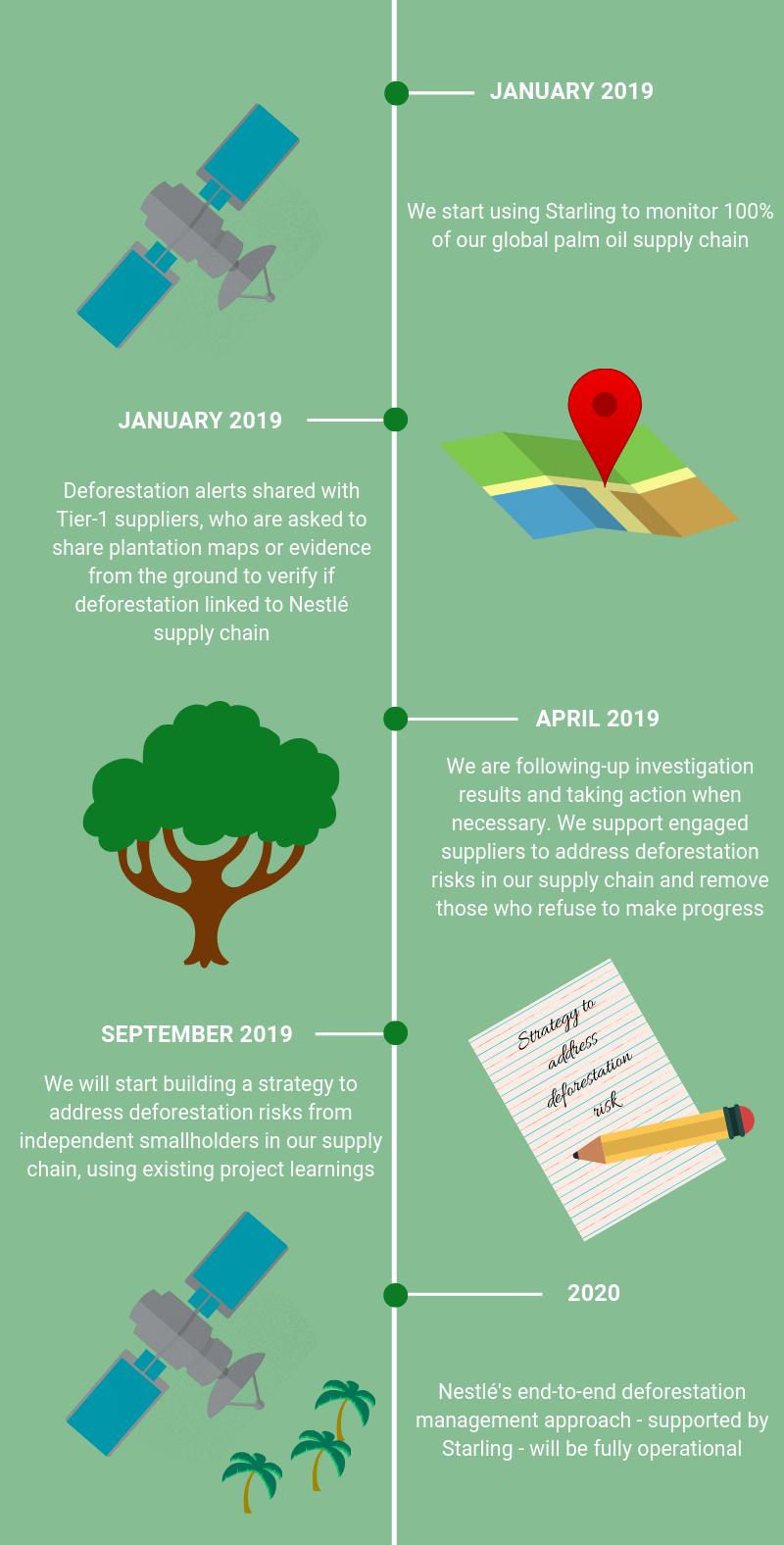
In September 2018, we became the first global food company to implement Starling, a satellite-based service developed by Airbus and Earthworm Foundation, to monitor our global palm oil supply chains.
Or progress on deforestation free supply chains is regularly recognized by Global Canopy in the Forest 500 benchmark where Nestlé is among the top performing companies.
2 This performance number differs from the one available in our Non-Financial Statement 2025 due to a change in the methodology during the first half of 2026. Now we consider ingredients volumes converted back to their original fresh state, instead of their processed form.
How are you addressing human rights issues in the palm oil sector ?
Human rights abuses, including forced labour and child labour, are unacceptable. We work with suppliers, partners and other stakeholders to assess, address and remediate human rights risks in our palm oil supply chain, while supporting collective action to address their root causes.
Our approach is guided by our Human Rights Framework and Roadmap and our Responsible Sourcing Core Requirements. These Requirements need to be complied with by all actors forming, directly or indirectly, part of our supply chain and constitute an integral part of our contracts with our direct suppliers. They set out expectations aligned with applicable laws, international standards and our responsible sourcing requirements. As part of our human rights and environmental due diligence approach, we take action in our supply chain to assess risks, address them, and monitor and report on activities and their outcomes.
We engage directly with suppliers and sites in our supply chain to conduct assessments, develop time-bound action plans where needed, and monitor progress. These action plans may include prevention, mitigation and remediation measures, as appropriate. We also work closely with suppliers and other partners to improve transparency and traceability and to carry out assessments in the upstream supply chain.
We recognize that some social and environmental issues require long-term, tailored interventions to tackle their root causes. Progress depends on action across the industry involving companies, suppliers, workers, civil society and governments. We therefore use leverage and collaboration to actively support collective engagement to help address widespread, systemic environmental and social issues in the palm oil supply chain.
What happens if you receive a complaint about forced labor in palm oil plantations related to Nestlé?
We have a Supply Chain Grievance Management Process introduced in 2024 to further strengthen existing processes and establish an effective mechanism for addressing grievances related to suppliers in our supply chain, whether direct or indirect.
This process applies to all supply chain-related grievances concerning our Responsible Sourcing Core Requirements, local regulations, business ethics, environmental impacts, and human rights. This includes alleged breaches of our Responsible Sourcing Core Requirements by direct suppliers or entities within our upstream supply chain, as well as alleged non-compliance with local laws.
All grievances are assessed and investigated. Where concerns are substantiated, we work with suppliers to develop and implement time-bound remediation plans to address and remedy any negative impacts identified.
We are committed to engaging with and supporting suppliers throughout the remediation process. However, where suppliers are unwilling or unable to demonstrate meaningful progress in addressing substantiated grievances, we may decide to suspend or terminate the commercial relationship.
How does Nestlé work with the Roundtable on Sustainable Palm Oil (RSPO)?
Nestlé uses RSPO certification as one element of its approach to responsible palm oil sourcing. In addition to certification, we apply our Responsible Sourcing Core Requirements and conduct due diligence activities across our supply chain.
Many of the areas covered by the RSPO Principles and Criteria are also reflected in Nestlé's Responsible Sourcing Core Requirements, which set expectations for suppliers on issues such as forest protection, respect for human rights, labor practices and engagement with local communities.
In 2025, 100% of the palm oil sourced by Nestlé was RSPO-certified or equivalent, as reported in the 2025 Non-Financial Statement. Further information is available in the Environmental Disclosures.
What is the difference between your responsibly sourced performance and your certified palm oil sourcing (RSPO)?
Palm oil is one of the 14 key ingredients covered by Nestlé's responsible sourcing programme. Responsibly sourced performance is assessed against Nestlé's responsible sourcing criteria, including traceability requirements and compliance with our Responsible Sourcing Core Requirements at production level.
Certified palm oil sourcing (RSPO) measures the proportion of palm oil sourced from Roundtable on Sustainable Palm Oil (RSPO) certified sources.
RSPO certification is one of the tools used in our approach to responsible palm oil sourcing. In addition to certification, we apply our Responsible Sourcing Core Requirements and conduct due diligence activities across our supply chain.
A report by NGO, Solidar Suisse, alleged that migrant workers faced poor working and living conditions on palm oil plantations in Nestle’s supply chain in Malaysia including poor housing, living wage issues and lack of legal protections. Are the allegations true?
We take the issues raised in the report seriously and have processes in place to investigate and address concerns related to labor and human rights risks in our supply chain.
Human rights abuses, including forced labor, are unacceptable. The palm oil supply chain is complex and multilayered, with potential risks across a number of areas, and we are committed to sourcing palm oil responsibly.
In Malaysia, we work with the nonprofit organization Winrock International and our partner Earthworm Foundation on the Labor Transformation Program (LTP), which engages mills and plantations to identify and address labor and human rights risks.
Each participating mill and plantation receives a tailored action plan and support to address identified risks, while progress is monitored through follow-up engagement and assessment.
Is Palm oil bad for you?
Nestlé uses refined palm oil as an ingredient in a number of products. We meet, and often go beyond, all relevant food safety regulations and laws wherever we operate.
When eaten as part of a healthy diet, foods made using palm oil (such as bouillons, fried noodles, doughs, chocolate coatings or ice cream) typically make up only a small contribution to our daily intake of saturated fats and are not a health risk.
Nestlé has significantly reduced saturated fats in many of our products since adopting a corporate policy (pdf, 1.5Mb) on this in 2009.
Find out more
- Read more about responsible sourcing of palm oil
- Read the Nestlé Responsible Sourcing Core Requirements (pdf, 2Mb)
- Find the latest document on our responsible sourcing activities: palm oil sourcing 2021 (pdf, 570Kb)
Our Starling journey
Starling is helping us gain a better understanding of the deforestation risks around our palm oil supply chain. As we act on this knowledge we want to share our journey with you.
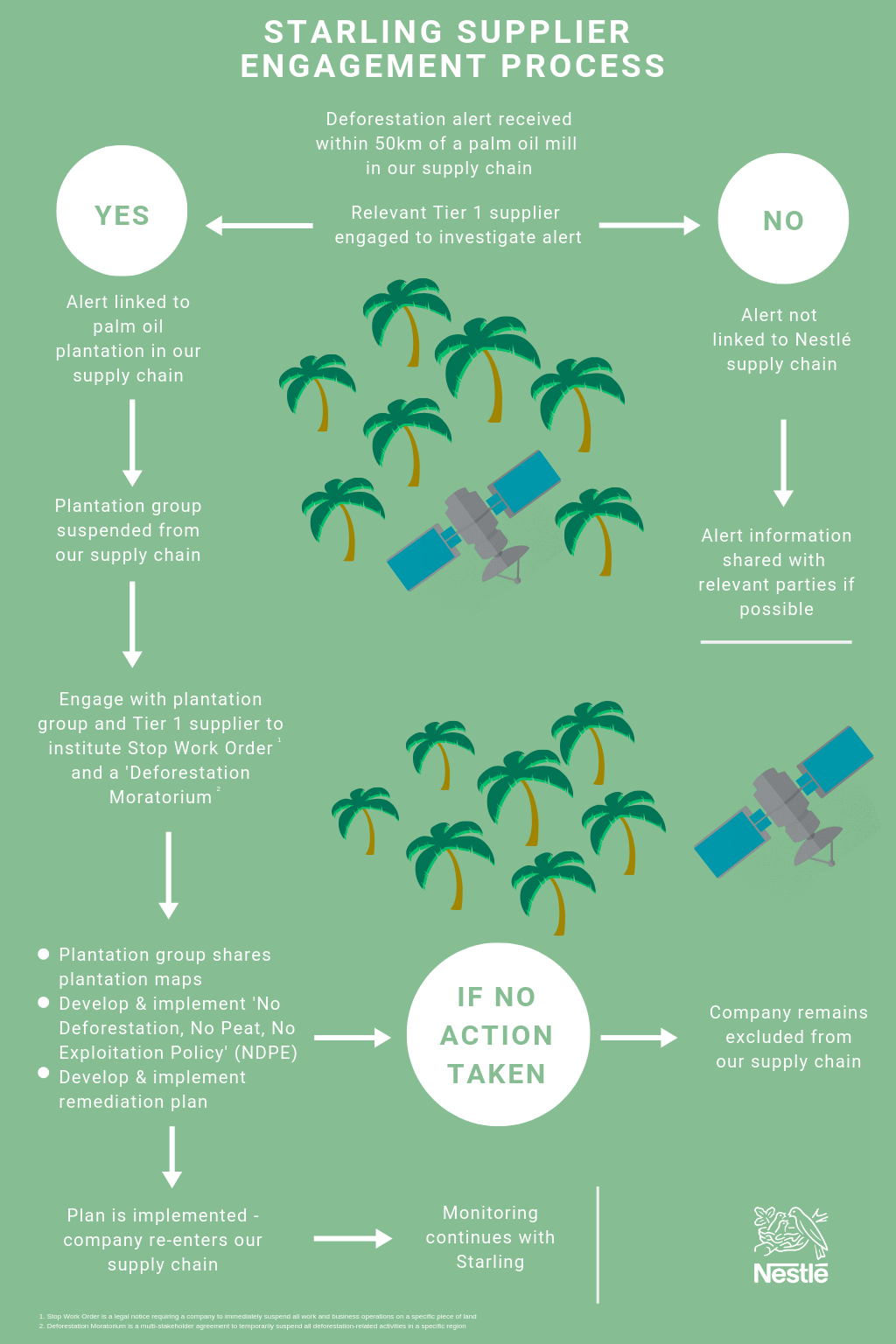
Engaging our suppliers
We use the data provided by Starling to engage our suppliers on deforestation risks. This graphic illustrates our engagement process.