What actions has Nestlé committed to for packaging sustainability?
Our vision is that none of our packaging ends up in landfills or as litter. We are working towards building a circular economy for post-consumer packaging materials. Our ambition is to use less packaging, better packaging materials, and to help build better systems for collection and materials recovery.
Less packaging
• Reduce use of plastic and virgin materials • Promote reusable and refillable systems
Better packaging
• Redesign packaging with alternative materials • Ensure recyclability and circular compatibility
Better system
• Support recycling infrastructure • Encourage sustainable behaviors across value chain
We have made a number of commitments looking toward 2025 on packaging sustainability as part of the Ellen MacArthur Foundation’s (EMF) Global Commitment.
- In 2018 we committed to making 100% of our plastic packaging reusable or recyclable. We report progress against this commitment every year. By the end of last year 89.5% of all our packaging met the reuseable, recyclable or compostable criteria.
- EMF and ISO 14021’s definition of 'recyclable' requires that products are designed for recycling, and that adequate infrastructure is in place locally to deal with it. Since 2022 it has been clear that while we are designing for recycling, plastics recycling infrastructure is not developing fast enough in many countries around the world. As a result, from 2022 we started to report an additional KPI: how much of our packaging is designed for recycling. By the end of 2025, we had achieved 87.5% designed for recycling.
- We are on track to reduce our use of virgin plastics in packaging by one third by 2025 and are working on alternative packaging materials such as paper, and materials with recycled content. We have already achieved a reduction of 28.0% virgin plastic as of year-end 2025 against 2018 baseline. Packaging plays an important role in safely delivering high-quality food and drinks to consumers, and in reducing food loss and waste. We need to consider alternatives carefully before making changes to packaging, whether plastic, paper, metal, or glass.
- We engage in the development of collection, sorting & recycling systems in selected countries, and have made strong progress in taking voluntary actions in this area. We support governments in accelerating infrastructure development by supporting the development of well-functioning collection, sorting and recycling schemes wherever we operate, and scaling up reusable and refillable alternatives where possible.
- We are working to integrate 30% recycled content into our plastic packaging materials and have reached 56.2% renewable or recycled content for all packaging in 2025, and 20.6% (2025) recycled content in our plastic packaging globally.
Recyclable
As defined in the Ellen McArthur Foundation reporting guideline definitions, a packaging or packaging component is recyclable if it is successfully post-consumer collected, sorted and recycled with a recycling rate of 30% in multiple regions, collectively representing more than 400 million inhabitants.
Reusable
Following ISO 18603, reusable is the characteristic of a product or packaging that has been conceived and designed to accomplish within its lifecycle an expected number of trips, rotations or uses for the same purpose for which it was conceived. The weight of reusable packaging is defined by the total weight of reusable packaging, divided by the number of expected rotations over the entire life of the package.
We have been investing in the shift from virgin plastics to food-grade recycled plastics, and to accelerate the development of innovative packaging solutions. Collaboration and collective action are vital for transforming how packaging is managed at end of a cycle, particularly if we are to advance the circular economy. Recognizing this, we opened the Institute of Packaging Sciences in 2019 to enable us to accelerate our efforts to bring functional, safe and lower emission packaging solutions to the market and to help address the global challenge of packaging waste management.
In addition to the work of the Institute, we are working with value chain partners, industry associations and the civil society to explore different packaging concepts. Such system-wide change takes time, but we are committed to creating a world without waste and delivering on the commitments we have made to achieve this.
We are committed to improving consumer information by clearly labeling our packaging with recycling instructions, helping ensure proper disposal. To support this, we’ve updated our back-of-pack communications to include nationally relevant waste management guidance for consumers.
We are determined to look at every option to solve these complex challenges and embrace multiple solutions that can have an impact now and in the future.
Did Nestlé change its plastics recyclability goal to be 'designed for recycling' rather than 'recyclable'?
An important component of ‘Design for recycling’ as per ISO 14021 is that packaging is designed for commonly used recycling infrastructure systems, based on industry standards.
In our Annual Creating Shared Value report, and with the Ellen MacArthur Foundation Global Commitment we continue to report the percentage of our packaging that is reusable, recyclable or compostable (89.5% in 2025) using the definition for in practice and at scale proposed by the Ellen MacArthur Foundation. The Global Commitment’s success depends not only on our product design, but also on the development of infrastructure for collection, sorting and reuse and recycling around the world for different plastic packaging materials. Governments have made strong progress in waste management infrastructure development, but the scale does not yet match the need. This is why we have restated our commitment in terms that we can more directly impact – design for recycling systems and virgin plastics reductions.
In 2022, we restated how we talk about our packaging commitments, recognizing that despite strong progress on the 2025 Global Commitment to make 100% of plastic packaging recyclable or reusable, key targets are expected to be missed. As a signatory of the Ellen MacArthur Foundation Global Commitment, we aim to design above 95% of our packaging for acceptance in recycling systems by 2025.
As of the end of 2025, 87.5% of our plastic packaging had been designed for recycling. We have made strong progress in taking voluntary actions under our control, and we support governments in accelerating infrastructure development.
Some of our key achievements include:
- We have reduced the weight of our plastic packaging from 1.5 million tons in 2019 to 0.86 million tons at the end of 2025, as a result of product portfolio shifts and packaging redesigns.
- As of 2021, one quarter of our plastic packaging that had previously not been designed for recycling had been improved and redesigned so that it could be recycled. At the same time, we additionally phased out non-recyclable materials per our Golden rules and negative list.
- In reuse and refill systems, we have run over 20 pilots in 12 countries, and commercially provided products with Aldo, Waters, Circolution and others, but we recognize that more needs to be done here. We will work with our retail partners to increase and scale up reuse and refill systems.
Why do you use plastic in your packaging?
Our packaging plays a key role in protecting food, preventing food waste and ensuring the quality of our products. We use a range of materials, including glass, metal, paper and plastics.
Plastics offer a unique combination of malleability, light weight, non-breakable, hygiene and product protection, making them ideal packaging materials. We work to ensure that the minimum adequate amount of plastic packaging is used to pack products safely and aim to support the recovery of plastic at the end of its useful life cycle.
How much plastic packaging did Nestlé use in 2024?
Nestlé’s total plastics packaging usage in 2025 was 0.86 million metric tons, compared to 1.5 million tons in 2019.
How is Nestlé reducing its plastic usage?
We want to use less packaging material, including less virgin plastic. Examples of how we’re doing this include removing unnecessary plastic lids, accessories, layers and films.
We are working on phasing out plastics that are non-recyclable or hard to recycle for all our products per our Golden Rules and Negative List. For example, in Egypt, we removed the plastic tear-offs that cover the bottle cap and neck from Nestlé Pure Life water bottles, removing close to 240 metric tons of PVC. In the US, we eliminated the over-cap lids from all our Gerber 1st Food and 2nd Food puree tubs, removing over 2300 metric tons of plastics. Every year we publish examples of our most recent packaging innovation to reduce plastic in our Ellen MacArthur Foundation Global Commitment reporting.
What is stopping reuseable and refillable packaging systems from scaling up faster?
In a Reuse model, once the product has been consumed, the empty packaging is returned to a drop-off point or picked up at home, collected, washed and inspected, and refilled. In a Refill model, users refill their reusable containers at home or on the go.
Any new system needs time to reach economies of scale, which are necessary to achieve economic competitiveness while undercutting the emissions footprint of existing systems. Collaboration across industries and with retail partners is key to bringing new infrastructures to economies of scale, as no one actor can create a system alone. Reuse and refill systems need supply chains to be redeveloped at scale and enabled by legislation.
We also look to governments to create the enabling conditions, so that industry value chains can collaborate to build reuse and refill systems that are convenient for consumers to use.
Enabling conditions include:
- Legislation at the international or national level to improve reuse and refill systems for packaged consumer goods. These laws should recognize the differences between foods, beverages, personal care, household products, etc. and circularity credentials of existing packaging
- Decarbonization of logistics systems away from fossil fuels, and towards carbon neutral options.
- Support for investments to modify industrial infrastructure, e.g. investments in large-scale sorting, reverse logistics infrastructure, standardized pooled packaging, packaging return systems/bins or regional washing facilities.
- Implementation of regional or global standards on systems’ hygiene, safety and quality management.
- Retroplan of a minimum time frame required for the transition (i.e. 10 years’ transition).
- Deployment of communications programs to drive consumer acceptance and refill and packing return behaviors.
- Increase of consumer convenience through innovative business models, ensuring high packaging return rates.
We advocate jointly for reuse and refill with 300+ other companies in The Business Coalition for a Global Plastics Treaty. These companies endorse a vision which includes:
- Moving away from single-use plastics in favor of reusable and more durable solutions
- Designing products and systems for all plastics to be reused, recycled, in practice and at scale
- Accelerating the uptake of new business and delivery models at scale
Governments can help industry scale promising voluntary pilots and best practices with supporting legislation. Well-designed regulation can level the playing field for companies large and small and ensure the safe and circular use of these new delivery systems.
How are you developing alternative materials?
We are evaluating and developing various packaging materials in collaboration with industry partners. Our efforts include increasing the quantity of food-grade recycled plastic beyond rPET, paper packaging, and mono-material packaging to increase recyclability.
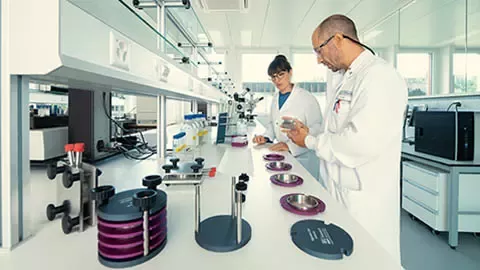
With regards to packaging innovation, we want to lead efforts in developing better packaging solutions for our products. That is why we established the Nestlé Institute of Packaging Sciences - the first of its kind in the food industry. Our team of packaging experts and scientists, together with partners, is working to develop and test functional, safe and environmentally friendly packaging solutions. The Institute collaborates closely with more than 180 packaging experts embedded in our global R&D network, as well as with research institutions, start-ups, and suppliers.
What are you doing to increase your use of recycled plastics?
Globally, our overall recycled plastic content use is currently 20.6%. Additionally, some of our products are predominantly packaged with recycled content today. We continue to work on increasing the proportion of recycled content we use in our packaging and continue to explore all opportunities to create and obtain sufficient volumes of food-grade quality recycled content.
We also want to reduce our use of virgin plastics, therefore we want to source food-grade recycled plastics and drive higher recycling rates with that.
You said that you were keen to 'create a market for food-grade recycled plastics' – what does this mean?
We have been exploring the share of recycled food-grade plastics, but globally there are a limited number of countries who permit food grade recycled packaging materials. Recycled food-grade plastics come in limited supply. The economics of plastic recycling are complex, but in nutshell, it’s cheaper today for plastic manufacturers to produce virgin plastics than it is to produce food-grade recycled plastics.
We are investing in recycled plastics and upgrading our packaging lines, while also supporting sustainability-focused companies through our venture fund to accelerate the shift toward recyclable, food-grade packaging across the industry.
Investments include those like: Nestlé invests USD 30 million in Closed Loop Leadership Fund, European Circular Bioeconomy Fund, Nestlé invested in Eureka!
What do you mean by the 'simplification' of packaging?
The simplification of packaging is important to help improve its recyclability. In order to simplify our packaging materials and packaging structures we have developed and circulated to suppliers a set of 'Golden Rules (pdf, 700Kb)' for the design and development of our packaging.
There are rules that apply to all packaging:
- Optimize the environmental performance of the packed product
- Optimize weight and volume of primary, secondary and transport packaging
- Use maximum possible recycled content
- Consider locally available infrastructure and technology
- Prepare appropriate disposal and/or recovery communication
The following rules apply specifically to plastics and coated paper:
- Do not use oxo-degradable plastics unless obliged by law
- Consider bio-based content for packaging
- Do not use polyvinyl chloride (PVC), polyvinylidene chloride (PVDC), polystyrene (PS), Expanded polystyrene (EPS)
- Prefer transparent or lightly tinted material, avoid carbon-based masterbatches
- Ensure residual products can be easily removed
How are you exploring bio-based and compostable packaging materials?
In September 2019, we inaugurated the Nestlé Institute of Packaging Sciences based in Lausanne, Switzerland. It has been mandated to accelerate the delivery of solutions to help us meet our packaging commitments for 2025.
The institute conducts world class research to fundamentally rethink packaging materials and how we use them to deliver longer-term sustainable solutions. The institute, together with our global R&D network, universities and innovation partners, conducts leading-edge scientific research that spans all aspects of packaging. As well as conventionally material types, which are known to be recyclable, we are also exploring the potential of bio-based and biodegradable materials and systems to determine which role they can play in packaging food products safely and improving future environmental opportunities.
One of the compostable packaging formats we sell today is the Nescafé Dolce Gusto NEO coffee pod.
How will you help develop plastics collection, sorting and recycling schemes?
To address the global issue of plastic packaging waste effectively, we must work collaboratively with industry, local and national governments, civil society and consumers to create systems solutions. We aim to do our part. We are determined to improve plastic packaging waste systems, which is why we are taking action to make our own packaging recyclable, support improving waste collection systems, using new types of packaging and helping make recycling the easy thing to do. As part of this approach, Nestlé aims to take an active role in supporting governments in the development of well-functioning collection, sorting and recycling schemes across the countries where we operate.
The future will be shaped by more than voluntary commitments, with a legally-binding Global Plastics Treaty under negotiation, and the prospect of new national regulation that may follow if there is an agreement. Regulation could shape the plastics system transformation by moving from voluntary programs to mandatory legislative frameworks.
Successful recycling requires an adequate infrastructure. We have identified several countries where we are focusing efforts to increase recycling rates, and further countries where we are focusing on achieving plastics recovery. The exact nature and scope of the role we play depends on the local context and needs to better achieve tailored outcomes.
We initially identified 12 countries (Colombia, Ecuador, Egypt, Ethiopia, Ghana, India, Indonesia, Malaysia, Nigeria, Philippines, Thailand and Vietnam) where waste is often mismanaged and leaking into lands and waterways. Today we have dozens of waste management projects, working with partners and associations to scale up collection, sorting and recycling of packaging waste. The aim is keeping packaging material in the economy and out of the environment. In these projects, our ambition is to collect and recycle the same amount of plastic we place on the market, while aiming to support the improvement of recycling rates and infrastructure. This includes support for well-designed and effective mandatory Extended Producer Responsibility and Deposit Return Programs.
How can you help consumers recycle product packaging correctly?
We are committed to raising awareness and informing our consumers about the appropriate way to dispose and recycle our product packaging, including by on-pack labeling. Consumers have a vital role to play in improving recycling rates and we will engage them through educational campaigns. We will do this through our brands and through our corporate communications channels.
For example, we have introduced a digital platform to help consumers dispose of their packaging waste appropriately in Italy, and our Nescafé Dolce Gusto brand launched a consumer education campaign to promote recycling in Germany and in Mexico. To accelerate internal change toward our packaging sustainability objectives, we have developed and rolled out a packaging sustainability training program for all of our employees.
Does Nestlé use plastic credits to achieve plastic neutrality?
No. We do not use plastic credits, instead we engage in direct collection, sortation and recycling or recovery partnerships.
Nestlé does not use plastic credits & offsets. Why?
Plastic credits have been proposed across various sectors as a transitional system until countries developed mandatory Extended Producer Responsibility (EPR) laws. Our approach is different: we aim to address the root cause of the plastic pollution challenge, namely by designing our packaging for recycling systems, advocating for well-designed EPR systems, and by supporting collection projects in countries that have not yet scaled up their waste management systems.
Further, there are many different and sometimes contradictory global and national schemes, standards, and certifications for plastic credits. The effectiveness of plastic credits requires a credible, solid, and harmonized global standard.
So why are there several journalists citing an example of Nestlé purchasing credits?
In 1 of the 185 countries where we operate, the Philippines, a service provider with whom we operated during 2020-2022 issued plastics credits for waste collection services. The former provider continues to list the credits on their online database, though those credits were not used as an offset to achieve plastic neutrality. In the Philippines, the EPR law specifically defines EPR credits and a credit market as an option in legal compliance.