Hazelnuts sourcing

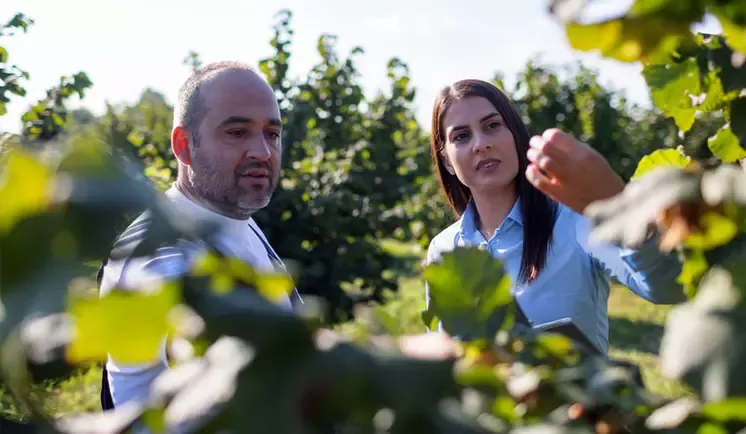
We source thousands of tonnes of hazelnuts annually. They are an important ingredient in our confectionery products - especially chocolate.
As well as being used whole, hazelnuts can be roasted, powdered and puréed.
Our approach to sourcing hazelnuts
While the bulk of our hazelnut supply comes from the Black Sea region of Türkiye, the world’s largest producer, we also source from other countries like Spain, Italy, and Azerbaijan. We do not source directly from farms – we buy from suppliers that obtain hazelnuts directly from farmers or through intermediaries.
As part of our Human Rights Framework and Roadmap, we have developed action plans for the most salient issues in our supply chains. Forced labor and responsible recruitment, as well as child labor and access to education and health and safety at work have been identified as key challenges within the hazelnut supply chain.
Since 2011, Nestlé has been working with the Fair Labor Association (FLA) to improve labor practices in the Turkish hazelnut sector. Partnering with our suppliers Ofi, Balsu and Yavuz, we have supported programs intended to improve human rights and labor standards in our supply chain.
The FLA has been assessing our suppliers’ human rights due diligence systems and helped build their capacity to address risks. Our suppliers have implemented projects to improve the living and working conditions for seasonal migrant workers from the southeast of Türkiye, as well as to provide safe spaces for their children as a way to address risks of child labor.
To drive industry-wide transparency, we publish a list of our direct hazelnut suppliers (pdf, 100Kb) in our supply chain and their corresponding cracking sites, along with their countries of origin.
Promoting decent work in the Turkish hazelnut sector
In Türkiye, the hazelnut supply chain contains challenges, especially concerning labor conditions and child labor risks. We work closely with partners and suppliers to address these.
Our three suppliers in Türkiye - Ofi, Balsu and Yavuz - all carry out a range of activities, interventions and collaborations designed to increase awareness of human rights among workers and farmers in our hazelnut supply chain. They are also all engaged in projects that aim to improve working and living conditions of seasonal migrant workers and provide activities and safe spaces to children to reduce child labor risks. Our suppliers work with several local partners, including local authorities, universities, the Turkish National Employment Agency, the Agriculture Ministry and Ministry of Family, Labor and Social Services to provide essential training.
Central to this work is mapping, training and registering labor contractors with the Turkish National Employment Agency and formalizing working agreements between farmers, seasonal workers and labor contractors. Various trainings are also held with farmers and workers on topics, such as prevention of child labor risks, health and safety, good social practices, and others.
Efforts are also made to improve workers' living conditions, including refurbishment of their living spaces and the provision of water and sanitation. Education in good agricultural practices is provided to farmers during harvest periods, and workers also receive personal protection equipment.
In Türkiye, there is a particular focus on preventing child labor risks, with the provision of summer schools and safe spaces for the children of migrant workers.
We support our suppliers in running summer schools designed to help address child labor risks, a prevalent issue in the agriculture sector in Türkiye. The hazelnut harvest occurs during school holidays, and due to a lack of wider infrastructure and facilities, the children of workers may accompany their parents to the hazelnut orchards, increasing the risk that they might engage in work.
To tackle this, we have collaborated with our suppliers to open summer schools, with educational, sports and arts activities organized to appeal to children's interests and provide more extracurricular gains. This approach aims to increase participation in education among children.
An FLA social impact assessment shows that our efforts targeting child labor risks have been successful. In particular, villages with summer schools have seen a fall in the number of children engaged in activities posing a risk of child labor compared to those without.
As well as providing children with safe spaces and activities, summer schools raise awareness about child labor among teachers and local villagers.
Developing women’s skills
In general, there is a lack of awareness of social and agricultural issues among people in the hazelnut production process, especially around gender-based employment relations and child labor risks. There is also a need to help people boost their income.
The Women on the Road program, led by our supplier, Ofi, has impacted hundreds of women and men each year. The project aims to emphasize the important role women play in the supply chain and to empower them with training about their rights. The information focused on occupational health and safety rules, reproductive health rights, child rights, careers and business life.
Gender stereotypes can be present among workers in our hazelnut supply chain, and when roles and responsibilities are guided by gender, rather than by skill and ambition, girls may face disadvantages in education and training.
Our supplier, Ofi, set up a project to provide a neutral environment in which girls could learn and play alongside boys, participating in traditionally male-dominated activities such as football and science fairs. The aim was to break down gender stereotypes and offer the children a safe space to prevent them from working on farms during the harvest.
With many hazelnut harvest workers being seasonal migrants, there is a need to help ensure they have adequate living conditions and access to drinking water and sanitation facilities. As part of our work with our supplier, Yavuz, we have contributed to improving living conditions for workers by co-funding their activities.
In partnership with local village heads, Yavuz restored and expanded some buildings to act as living areas during the harvest for dozens of seasonal migrant workers. Mobile toilets and showers were also installed, which provide access to sanitation to over a hundred seasonal workers and villagers during the harvesting season.
Collaborating with industry partners to improve the hazelnut supply chain
We support the FLA's Harvesting the Future project in Türkiye. The project is a multi-partner and multi-commodity program designed to improve recruitment practices and reduce child labor risks in the Turkish agricultural sector. Seasonal migrant workers, who travel as families from crop to crop for six to eight months each year, are particularly vulnerable to unethical labor practices. Aimed at supporting labor and living conditions beyond thehazelnut harvest, reducing child labor risk and improving recruitment practices during migration journey, the program has supported traceability, awareness of human rights due diligence and capacity- building across crops.
The second phase of the project focuses on capacity building of producers on responsible sourcing and supporting them to implement requirements at farm level, responsible recruitment, implementation of effective grievance mechanisms and the implementation of tools to better understand living wage.
We also support a public-private partnership between the International Labor Organization office for Türkiye and members of the Association of Chocolate, Biscuit and Confectionery Industries of Europe (CAOBISCO), aimed at helping address child labor risks in the seasonal agriculture sector. The project began in the provinces of Sakarya, Düzce and Ordu in 2013 and was extended to Samsun and Giresun in 2021.
The project facilitates the exchange of experiences between the government, the private sector, social partners and civil society in addressing child labor risks, particularly in the hazelnut supply chain. It also maximizes collective learning opportunities among the project stakeholders.
Key terms explained
Responsible recruitment
Responsible recruitment is recruitment carried out in a manner that respects and protects workers' rights, is free from fees charged to workers, and prevents exploitation, forced labour, and human trafficking.
Responsible recruitment
Responsible recruitment is recruitment carried out in a manner that respects and protects workers' rights, is free from fees charged to workers, and prevents exploitation, forced labour, and human trafficking.
Responsible sourcing
For Nestlé, responsible sourcing means improving the traceability of our ingredients and monitoring how they are produced. This involves applying our environmental and human rights requirements - detailed in our Responsible Sourcing Core Requirements (pdf, 2Mb) - at the different stages of our supply chain. Examples of these requirements include that land and resources of Indigenous Peoples and local communities are respected and that no deforestation and no conversion of forests and other ecosystems occur in our supply chain. Read more about responsible sourcing.
For Nestlé, responsible sourcing means improving the traceability of our ingredients and monitoring how they are produced. This involves applying our environmental and human rights requirements - detailed in our Responsible Sourcing Core Requirements (pdf, 2Mb) - at the different stages of our supply chain. Examples of these requirements include that land and resources of Indigenous Peoples and local communities are respected and that no deforestation and no conversion of forests and other ecosystems occur in our supply chain. Read more about responsible sourcing.
Good agricultural practices
Farm-level and post-farm practices ensuring efficient agricultural production aligned with environmental, social and economic performance objectives.
Farm-level and post-farm practices ensuring efficient agricultural production aligned with environmental, social and economic performance objectives.